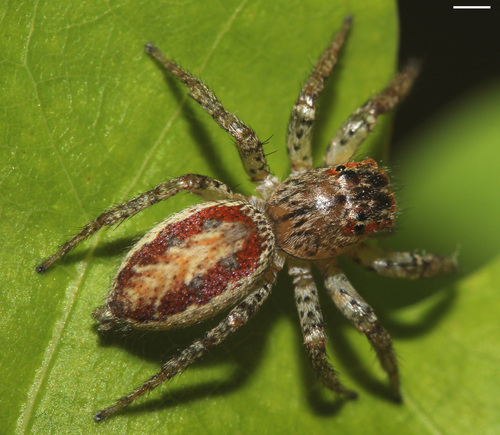
About Telamonia festiva Thorell, 1887
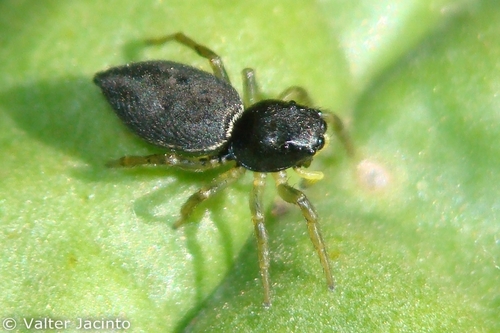
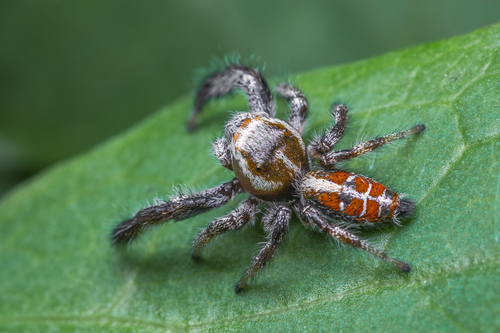
Telamonia festiva Thorell, 1887 can be easily identified by a series of chevron-shaped markings running along the full length of the dorsal stripe on its opisthosoma, or abdomen. This species shows sexual dimorphism in both coloration and body size. Males are predominantly black and white, and they lack the elongated front legs that characterize male Telamonia dimidiata. In males, the retrolateral tibial apophysis, also called RTA, is sharply pointed. The original description records that males have an approximate body length of 7 millimeters.
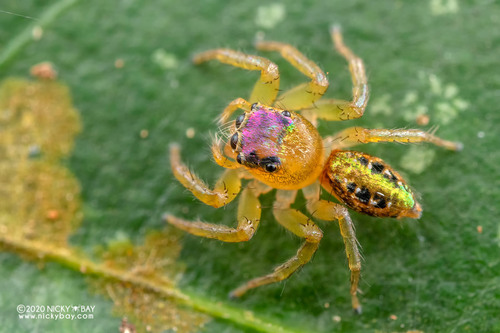
Female coloration is variable, but in addition to the characteristic chevrons on the dorsal opisthosoma, females typically have three stripes of white to off-white scales across their eye region. Thorell's original description of the female notes a body length of 11.5 millimeters. The female has a testaceous, or yellowish-brown, cephalothorax marked with reddish spots, most notably between and behind the eyes. The female abdomen is described as long and narrow, testaceous in color, covered in dense silky pale yellow pubescence, and decorated with two longitudinal black bands that have red margins along their anterior sections.
Telamonia festiva has a wide distribution across tropical Asia. It has been documented in India, Sri Lanka, Nepal, China, Taiwan, Vietnam, Cambodia, Myanmar, Thailand, peninsular Malaysia, Bornean Malaysia, Singapore, Indonesia (Sumatra, Java, Sulawesi), and the Philippines. This species occurs in a range of different habitats across its distribution, including tea plantations in the Dooars region of West Bengal, India.