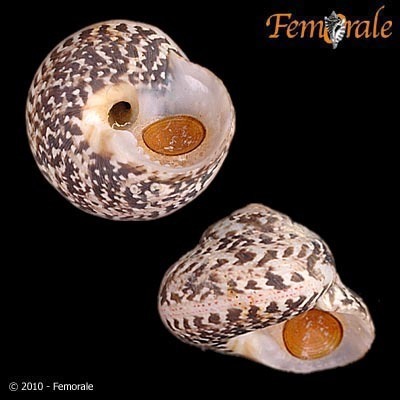
About Tegula pulligo (Gmelin, 1791)
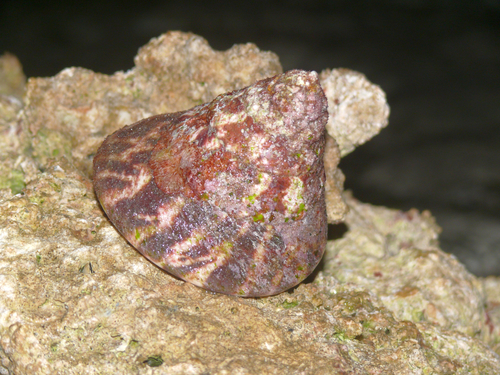
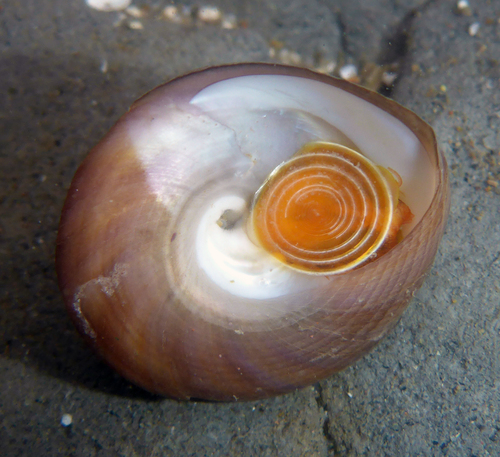
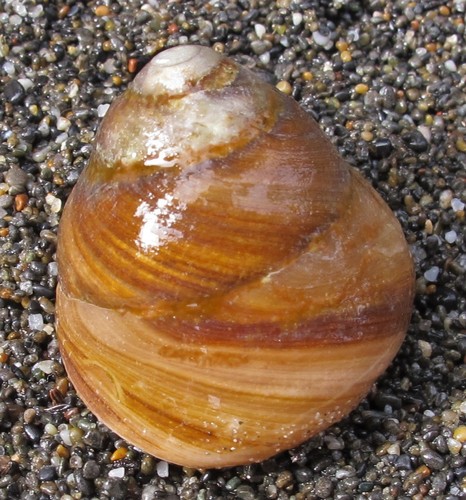
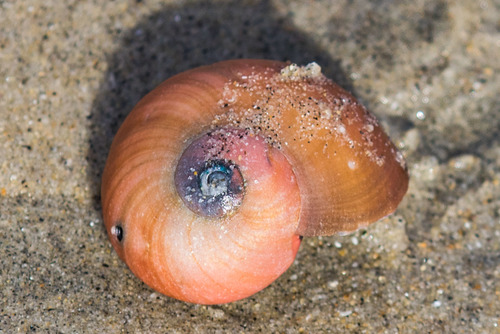
The shell of Tegula pulligo ranges in size from 19 mm to 41 mm. This solid shell is deeply and widely umbilicate, with a conical shape and an elevated spire. Its color is dull purplish or brown; worn shells are often orange, and may be obliquely streaked with white or solid in color. The species has seven flattened whorls: the upper whorls are finely spirally striate and sometimes very faintly folded, while the remaining whorls are smooth and obliquely finely striate. The base of the shell is flattened and slightly convex, marked with oblique streaks, and concave and white around the umbilicus. The body whorl has a blunt angle at its periphery. The aperture is very oblique, and smaller than is typical for other species in this genus. The thin columella has a blunt tooth, and ends at the top in a white callus that partially covers the umbilicus. There is no spiral ridge inside the umbilicus. This species is distributed in the Pacific Ocean from Alaska to Baja California, Mexico. It typically lives on kelp, and becomes easy prey for multiple predators including sea stars, whelks, and octopus once it falls to the seabed.