About Tegula montereyi (Kiener, 1850)
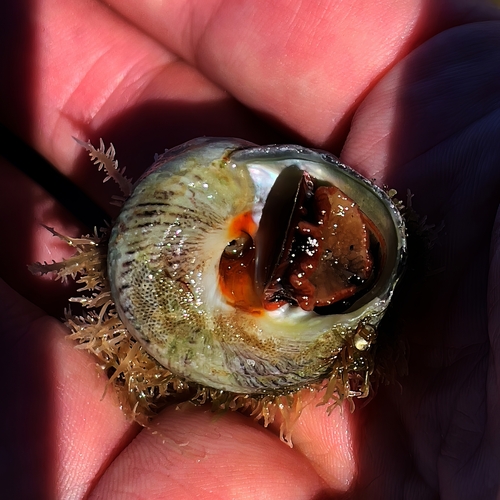
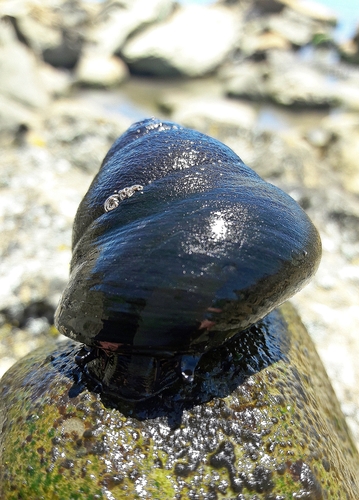
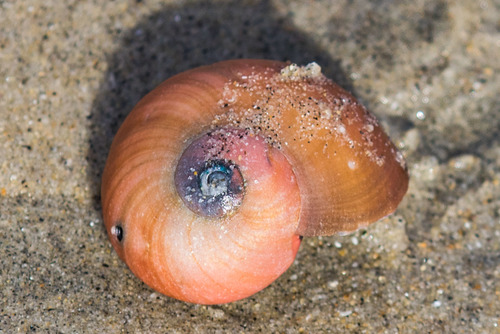
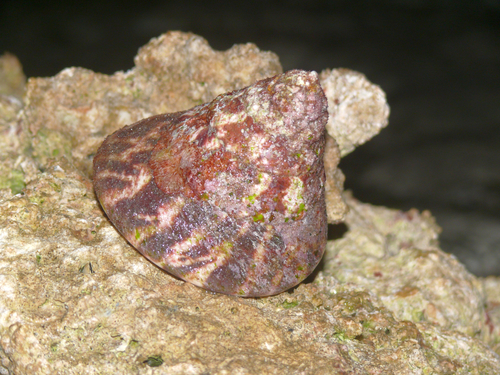
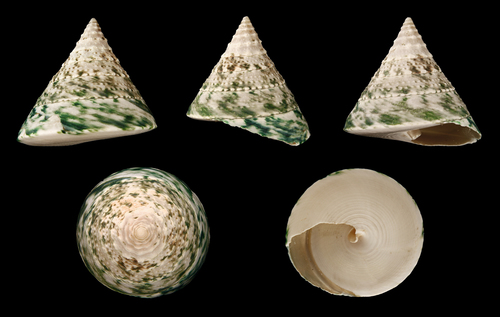
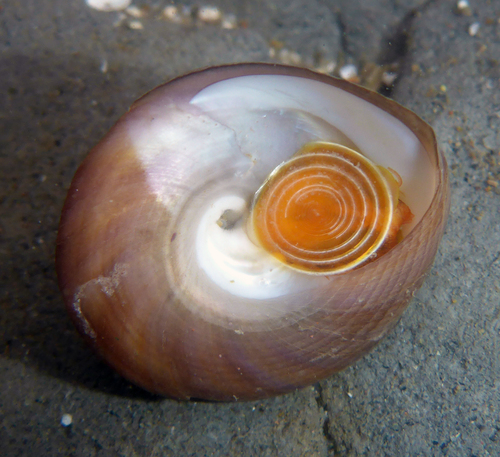
The shell of Tegula montereyi ranges from 28 to 39 mm in height, and 34 to 42 mm in diameter. It is a rather thin, umbilicate shell with a strictly conical shape, and is colored light olivaceous or pale corneous. The spire is conical with nearly straight outlines, the apex is acute, and the sutures are linear. There are seven flattened whorls, encircled by numerous fine lirae that become obsolete on the lower whorl. The lower whorl usually features very ill-defined, small, obliquely descending folds that lie at right angles to the incremental striae. The body whorl is acutely angular at the periphery. The base of the shell is flat, with spirally arranged, subobsolete lirae. The aperture is subhorizontal. The outer lip is thin, and margined with brown or corneous. The columella is subhorizontal and curved, it is toothed below the middle, recedes above, and does not spread around the umbilicus as seen in some other species of this genus. The umbilicus is funnel-shaped, it rapidly becomes very narrow, is white inside, and has an edge defined by an angle. This species occurs in the Pacific Ocean off the coast of California, USA.