About Tegula gallina (Forbes, 1852)
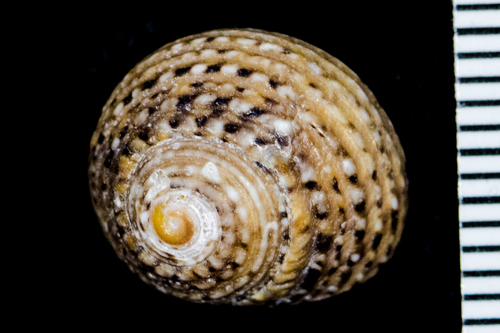
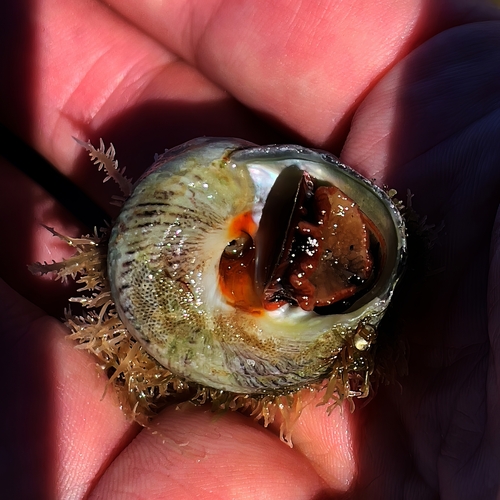
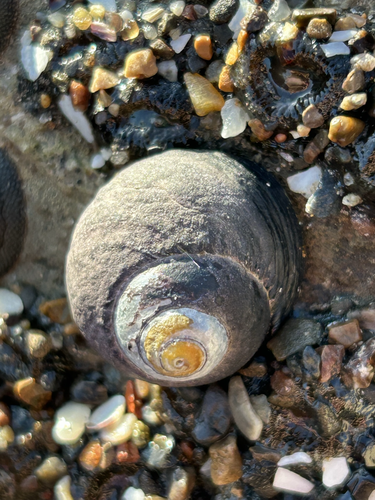
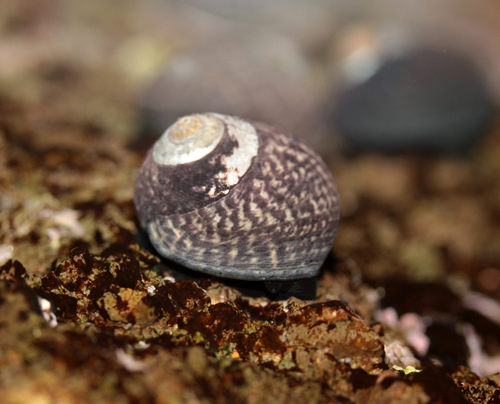
The scientific name of this species is Tegula gallina (Forbes, 1852). The shell of T. gallina is typically 1.9 to 4.1 cm (3⁄4 to 1+5⁄8 inches) in both height and width, though it may be slightly taller than it is wide. This imperforate, heavy, solid, thick shell has an elevated conoidal shape. Its color pattern consists of crowded, slanting axial stripes that alternate between whitish and purplish-grey or blackish, and are speckled with whitish. These stripes sit in the interstices between the shell's close, narrow superficial surface folds. These folds may be well-defined, barely visible, continuous, or cut into granules by similarly close spiral furrows; spiral furrowing is sometimes the dominant feature of the surface. The shell has 5 to 6 convex, rough whorls, that are usually indented a short distance below the suture. The spire has a conoidal shape. The apex is typically blunt, eroded, and yellow. The body whorl is rounded at its periphery. The convex base often has an eroded area in front of the aperture, located above a closed umbilicus; the area surrounding the umbilicus is usually white. The oblique aperture is nearly circular. The outer lip has a black edge, and is smooth and pearly on the inside. The columella is short, curved, and distinctly two-toothed near the base. A small pit marks the location of the umbilicus. The description above applies to the typical form of the species. The surface sculpture of T. gallina is superficial and highly variable, just like the distribution of its color markings, which depends on the sculpture. It can sometimes be difficult to distinguish T. gallina from Tegula funebralis. T. gallina inhabits intertidal rocks. Its geographic range extends from Santa Barbara County, California, to Baja California along the Pacific Ocean. Larger individuals of this species are found in the southern part of its range, and T. gallina is often found living alongside the less common Black Tegula (T. funebralis).