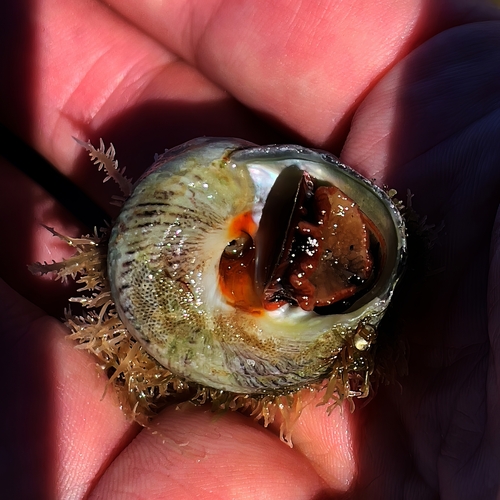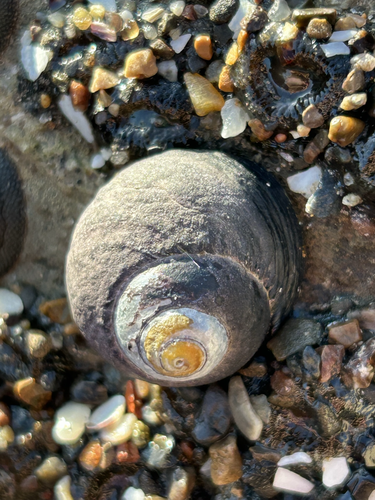
About Tegula funebralis (A.Adams, 1855)
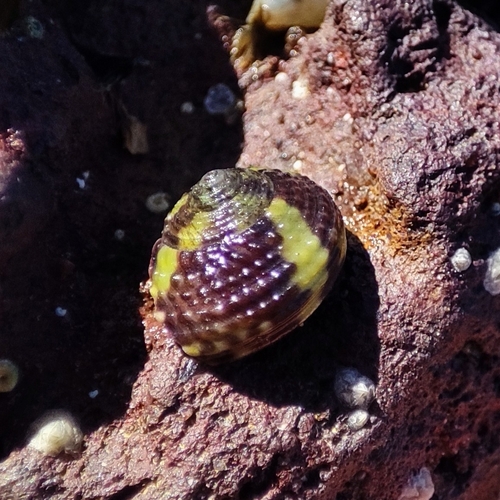
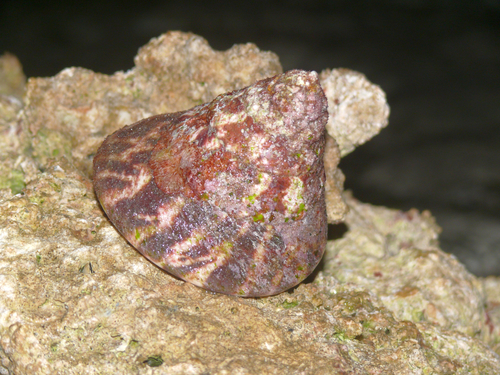
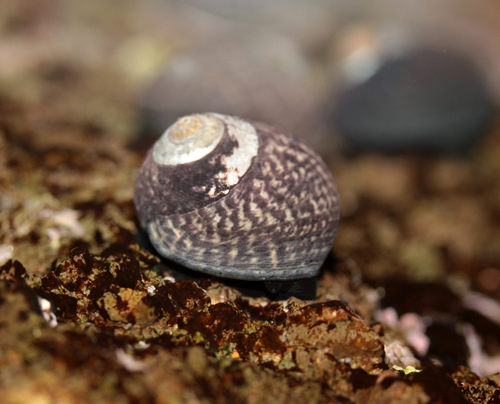
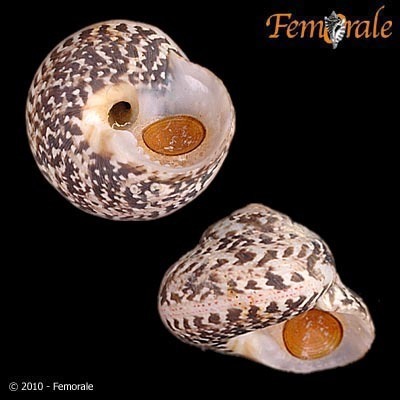
This species, commonly called the black turban snail, has the scientific name Tegula funebralis (A.Adams, 1855). Most adult individuals have shells 20 to 50 millimeters (about 1 inch to 1 and three quarters inches) in diameter. Adult black turban snails weigh between 2 and 20 grams. Individuals live between 7 and 30 years; studies show that individuals living in the more northern parts of the species' range are larger and live longer on average than individuals living in the southern parts. In 1971, a new sense organ was discovered in this marine snail. Chemoreceptor organs are found near the base, on the border of the leaflets of the ctenidium (the comb-like respiratory gills), with one organ on each leaflet. These organs form a light swelling near the base of the leaflet, with a pocket inside the swelling. Collectively, this set of organs is called a "bursicle". Black turban snails are distributed along the Pacific coast of North America, ranging from British Columbia to Baja California, where they are one of the most abundant snail species. Studies have recorded densities as high as 1,400 individuals per square meter near Monterey, California. Local population densities are affected by many factors, including the abundance of food, predators, and suitable habitat. This species lives in rocky intertidal zones, between the low and high tide lines. Juvenile black turban snails are found mostly under rocks and among coarse sands. Empty black turban snail shells are often used by another common intertidal animal, the hermit crab. Archaeological evidence shows that humans have used black turban snails for over 12,000 years. The edible portion of an individual snail can weigh between less than one gram to 8 grams. It has been estimated that an average human would need to eat around 400 of these snails per day to meet minimum caloric needs if it were their only food source. Evidence for human consumption of black turban snails includes the discovery of shell middens found alongside tools that researchers call "turban crackers". Evidence from several late Holocene middens suggests that harvesting of this species increased around 3,000 years ago. Analysis of middens found near Point Conception shows that black turban snails made up as much as 60% of the meat yield for native people in that area. Researchers speculate that the common practice of eating these snails was likely influenced by their high abundance and the ease of collecting them.