About Tegula eiseni E.K.Jordan, 1936
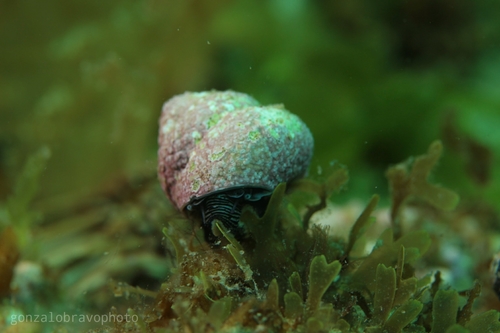
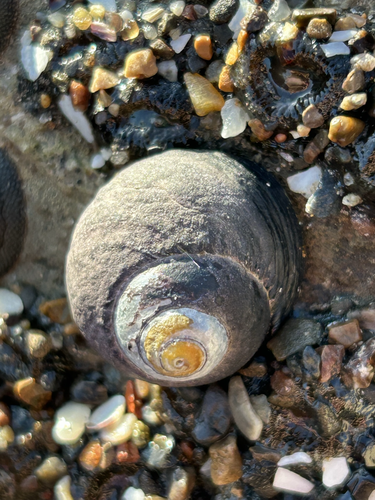
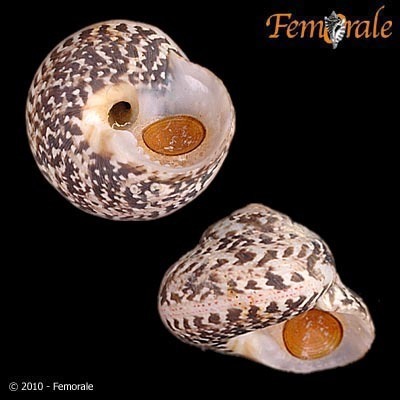
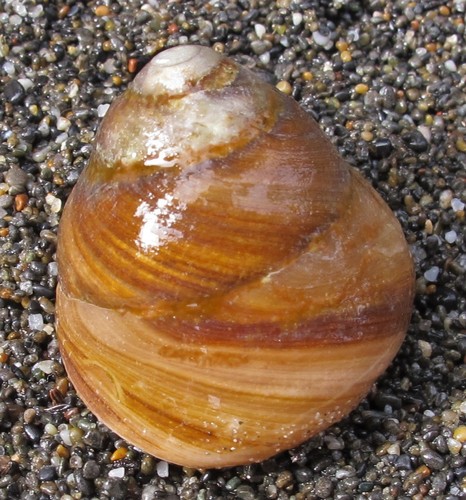
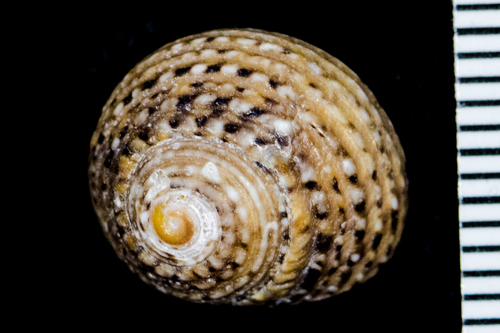
Tegula eiseni is a species of snail first described by E.K.Jordan in 1936. Its shell is conical, ranging in size from 13 mm to 22 mm. The shell is covered with 12 to 13 spiral ribs, which are coarse and nodded above the widest part of the whorl. This snail has a corneal operculum that closes the rounded opening of its shell, and a deep umbilicus is present on the underside of the shell. This species is found in the Pacific Ocean, ranging from central California, USA to Baja California, Mexico; its specific range extends from Los Angeles, California to Magdalena Bay in Baja California Sur. Tegula eiseni lives in the intertidal zone, from the shore down to 18 meters in depth, where it grazes on algae that grows on rocky substrates. Common predators of T. eiseni include octopuses, sea stars, and Kellet's whelk, though T. eiseni is often not the predators' preferred food source. Unlike closely related tegula snails such as Tegula aureotincta, which use locomotion to defend against predators, T. eiseni has evolved a thicker shell to deter predators. Even with this defense, T. eiseni is most common in habitats with lower predator densities. This species reproduces via two spawning events per year, one in spring and one in fall. Most individuals engage in partial spawning, though total spawning has also been observed. Tegula eiseni is dioecious: female reproductive organs are moss green, while male reproductive organs are cream colored. Females undergo oogenesis between January and April, with gonadal maturation occurring in late summer and fall. After spawning, young T. eiseni reach the veliger developmental stage 2 days after hatching, and fully settle 2 days after reaching the veliger stage. Juvenile teleoconch development begins 12 days after initial fertilization, and juveniles become morphologically mature approximately 60 days after fertilization.