About Tegula atra (Lesson, 1831)
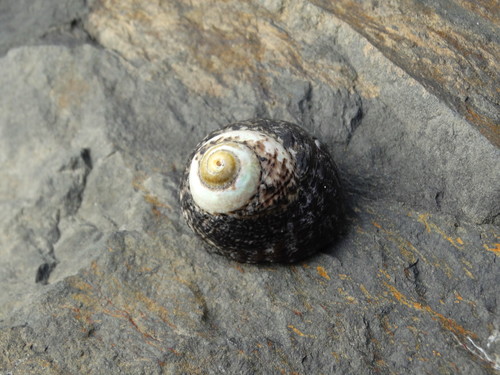
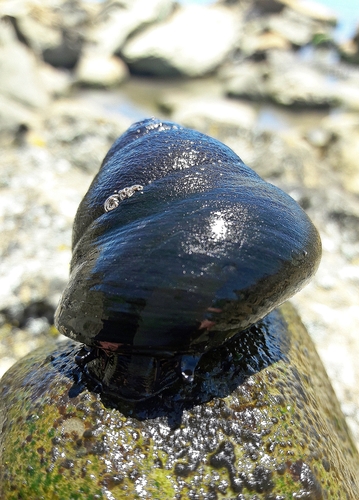
This species, Tegula atra (Lesson, 1831), has a shell whose size ranges from 24 mm to 62 mm. The shell is heavy, solid, and imperforate, with a more or less depressed conical shape. It is a lusterless black color. The shell has approximately six moderately convex whorls, separated by impressed sutures. The whorls are smooth, with only faint incremental striae. The body whorl is also more or less depressed, and is rounded or subangular at its periphery. The base of the shell is flattened, concave at the center, and it is eroded and light purplish in the area in front of the aperture. The aperture is very oblique. The outer lip has a black margin, and is smooth and pearly on the inner surface. The columella is oblique, with an obtuse tooth in its middle section. The umbilico-columellar tract is covered by a white callus, excavated at the position where the umbilicus would be, and it bears a spiral rib. This species is found in the Pacific Ocean, along the coast from the Strait of Magellan in Chile north to Peru.