About Tectus pyramis (Born, 1778)
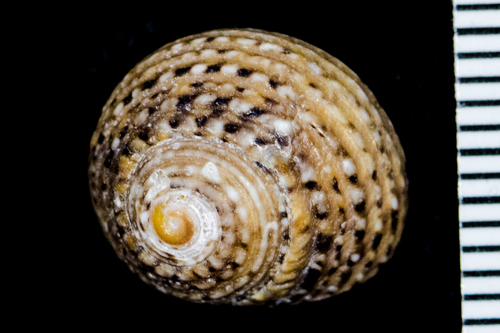
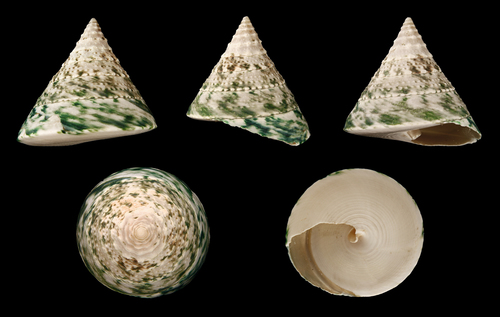
The shell of Tectus pyramis ranges between 45 mm and 105 mm in size. It is solid, thick, and strictly conical, with no umbilical opening. The spire is more or less tapered toward the top, ending in an acute apex. Shell color is typically yellowish or grayish, with varying degrees of mottling and marbling in green or brown; the shell base may be white, green, or brown. The shell holds 12 to 14 whorls. The upper whorls project slightly outward, and feature plicate, tuberculate, or undulating texture along the sutures; these folds and tubercles become indistinct on the lower whorls. Upper whorls are encircled by one or two spiral rows of small tubercles or beads, which grow to around five rows on the middle whorls. The body whorl is beaded, though it is smoother than the preceding whorls, and may also be finely radiately wrinkled or nearly smooth, with an angled periphery. The base of the shell is flat, marked with concentric smooth, wide lirae separated by shallow grooves; these lirae become indistinct toward the outer margin. The aperture is transverse, very oblique, and roughly triangular; the outer wall is grooved on the inside. The basal margin is straight, not concave in its middle section, and has a deep notch where it meets the columella. The inner sculpture shows revolving acute plicae that match the lirae circling the outer central area. The columella is very short, and bears a very strong, sharply keeled spiral fold. This species is found in the Indian Ocean off Chagos and the Mascarene Basin, in the Western Pacific Ocean, and in waters from Indonesia to Japan, Fiji, and Australia, where it occurs in Queensland, Western Australia, the Northern Territories, and Tasmania.