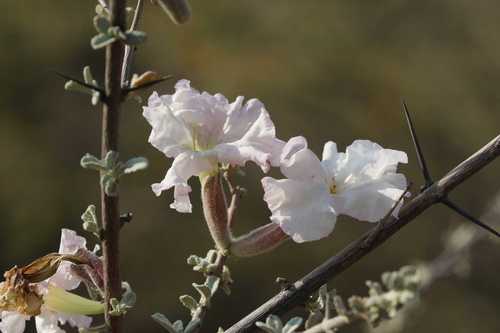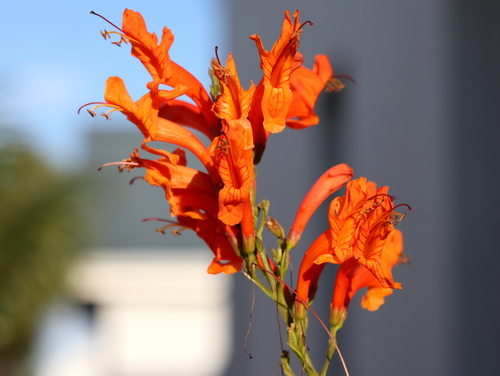
About Tecomaria capensis (Thunb.) Spach
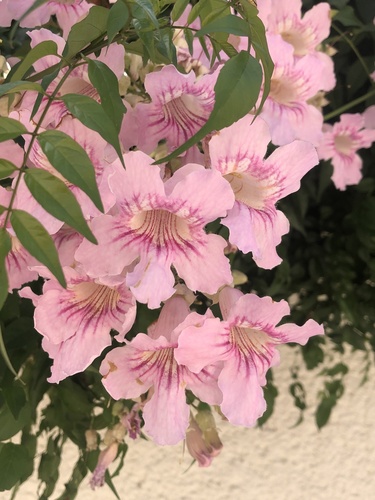
Tecomaria capensis (Thunb.) Spach is an erect, scrambling shrub that grows 2–3 meters (7–10 feet) tall, with a width of roughly the same measurement. It is normally evergreen, but may drop its leaves in colder climates. In some habitats, it grows as a scrambler, producing long growing tips that lean on other plants' stems and branches, as well as boulders, trellises, fences, and walls; this can make the plant look untidy. Its leaves grow up to 15 centimeters (6 inches) long. The leaves are arranged oppositely, have slight serrations, range in color from green to dark green, and are pinnate, with 5 to 9 oblong leaflets. This species is native to parts of southern and central Africa, including South Africa, Eswatini, Mozambique, Malawi, Tanzania, the Democratic Republic of the Congo, and Angola. It is cultivated in other regions around the world, including Southeast Asia, southern France, Hawaii, Florida, and California. It has been classified as invasive on remote islands such as the Azores, where it has been observed on São Miguel island, near Ponta Garça. For wildlife gardens in Southern Africa, Tecomaria capensis is an excellent choice, because sunbirds and certain insects are drawn to its nectar. As a scrambler, it can grow quite dense when pruned, so it can be used as a nesting site by several bird species. The larvae of the death's head hawkmoth (Acherontia atropos) and the fulvous hawkmoth (Coelonia mauritii) feed on this plant's leaves. Tecomaria capensis has been grown in cultivation for many years, and it is often used for hedging because of its scrambling growth habit. It can be propagated from cuttings, or by removing rooted suckers during its active growth phase. It can be planted in areas from semi-shade to full sun. It tolerates temperatures as low as 5 °C (41 °F), so it can grow in mild temperate regions when protected by a warm wall. In colder climates, it can be grown in a container and moved indoors for the winter. To keep the shrub neat and tidy, it must be pruned back in late winter to encourage new growth and flower production. Applying a balanced fertilizer after pruning improves the plant's growth and flowering. This plant has received the Royal Horticultural Society's Award of Garden Merit.