About Tecoma stans (L.) Juss. ex Kunth
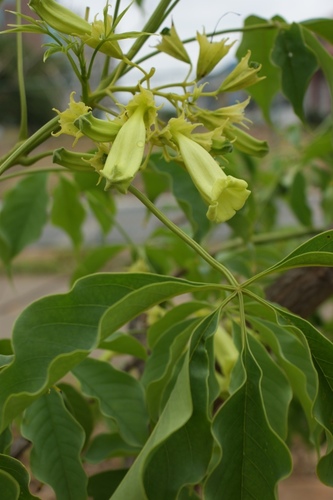
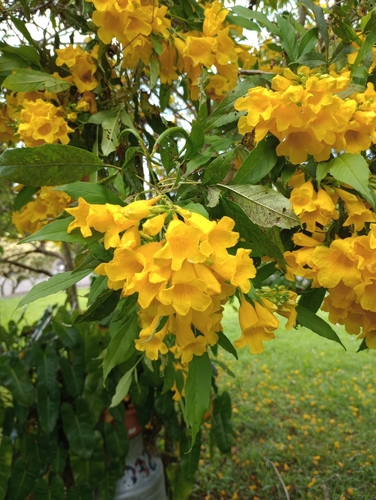
Tecoma stans (L.) Juss. ex Kunth is a semi-evergreen shrub or small tree that reaches up to 10 m (30 ft) in height. It produces opposite odd-pinnate green leaves, with 3 to 13 serrate leaflets that measure 8 to 10 cm long. The leaflets, which are glabrous on both sides, have lanceolate blades 2–10 cm long and 1–4 cm wide, with a long acuminate apex and a wedge-shaped base. Its large, showy, golden yellow, trumpet-shaped flowers grow in clusters at the ends of branches. The flower corolla is bell- to funnel-shaped, five-lobed and weakly two-lipped, often marked with reddish veins in the throat, and measures 3.5 to 8.5 cm long. Flowering occurs from spring to fall, with the heaviest bloom from spring to summer. Its fruits are narrow capsules formed from two carpels, growing up to 25 cm long. Each fruit holds many yellow seeds with membranous wings; when ripe, the fruit opens to release the seeds, which are dispersed by wind, a method called anemochory. The flowers attract bees, butterflies, and hummingbirds. In addition to sexual reproduction by seed, Tecoma stans can also be reproduced asexually via stem cuttings. Tecoma stans is native to the Americas, with a native range extending from the southern United States through Mexico, Central America, and the Antilles to northern Venezuela, and along the Andes mountain range to northern Argentina. It has been introduced to southern Africa, India, and Hawaii. It stays evergreen in moist, warmer regions, but becomes deciduous in more temperate regions with a pronounced dry season. Also known as yellow trumpetbush, this species is a ruderal species that readily colonizes disturbed, rocky, sandy, and cleared land, and occasionally becomes an invasive weed. It grows well in a wide variety of ecosystems, from high altitude temperate forests and tropical deciduous and evergreen forests, to xerophilous scrub and the intertropical littoral. It quickly colonizes disturbed, rocky, sandy, and cleared fields, and prefers dry, sunny coastal regions. Tecoma stans is drought-tolerant and grows well in warm climates. It is cultivated as an ornamental plant, grown across much of the world for its attractive flowers to decorate streets and gardens, and can be easily propagated by stem cuttings. The wood of Tecoma stans is used in rustic construction such as bahareque, to make furniture and canoes, and as firewood or charcoal. It is used as a medicinal plant to treat diabetes, digestive system diseases, and other conditions. When growing in pastures grazed by livestock, it makes good, desirable fodder. According to traditional Pakistani medicine, it is a very potent antidote to cobra venom, and is reported to be more effective than antiserum. A paste made from the plant's leaves is applied topically to cobra bites: the plant's biochemical compounds bind to cobra venom enzymes, effectively inhibiting the venom's activity.