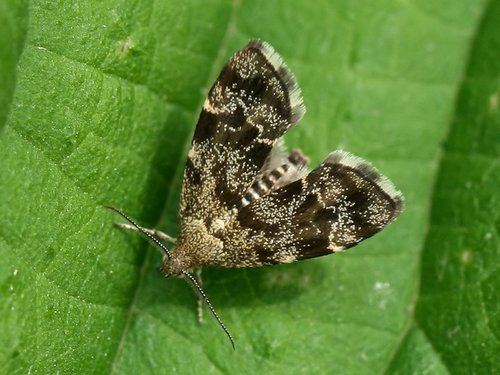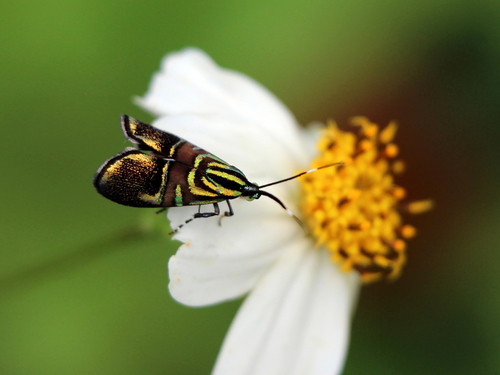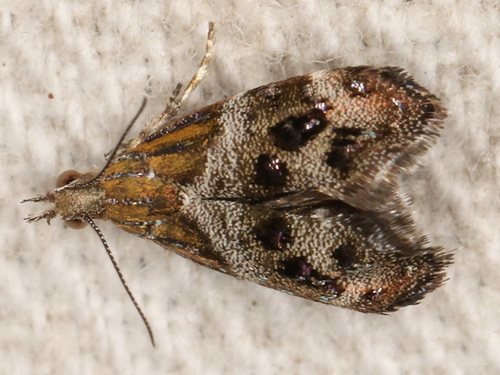
About Tebenna micalis Mann, 1857
Tebenna micalis has a wingspan of approximately 13 millimetres (0.51 inches). It is similar in appearance to the Nearctic species Tebenna gnaphaliella. Adults can be found between June and August; they are attracted to light, and may also be encountered during the day on flowers of the species' larval foodplant. The larvae of Tebenna micalis feed on plants in the family Asteraceae, developing within a leaf blotch mine. Sometimes larvae leave their initial mine and create a new one. Later larval instars can live freely in a silk web on the leaf. Recorded larval foodplants vary by location: common fleabane (Pulicaria dysenterica) in the United Kingdom; capeweed (Arctotheca calendula), spear thistle (Cirsium vulgare), horseweed (Erigeron canadensis), cotton thistle (Onopordum acanthium) and golden everlasting (Xerochrysum bracteatum) in Australia; and globe artichoke (Cynara scolymus) in Réunion. Larvae pupate on the underside of their host plant's leaf, inside a spindle-shaped cocoon. In Europe, this species is found south of the line connecting Ireland, Great Britain, France and Slovakia. In Britain, it is an irregularly occurring immigrant, first recorded there in the 1980s. Outside of Europe, Tebenna micalis has been recorded from China (Henan, Hubei, Jiangxi, Tibet, Zhejiang), Nepal, Russia, Japan (Honshu, Ryukyu Islands), Afghanistan, Tajikistan, Uzbekistan, Turkmenistan, the Canary Islands, North Africa, Arabia, Asia Minor, Zakavkazye, Iran, Lebanon, New Zealand, and the Oriental, Ethiopian, Australian and Nearctic regions.