About Tchagra tchagra (Vieillot, 1816)
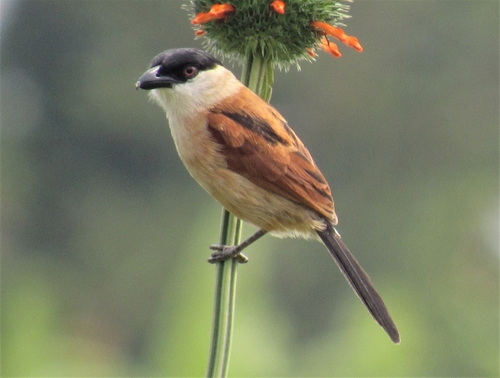
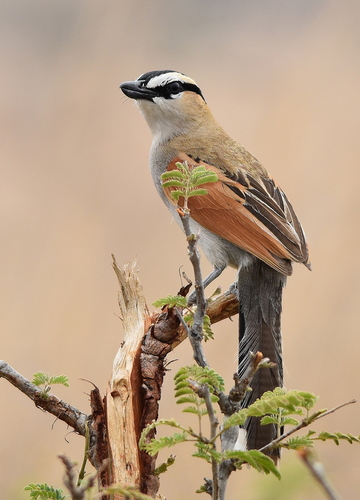
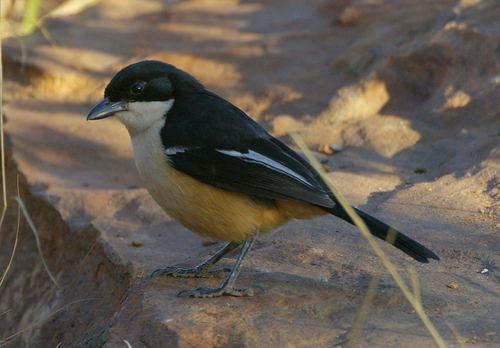
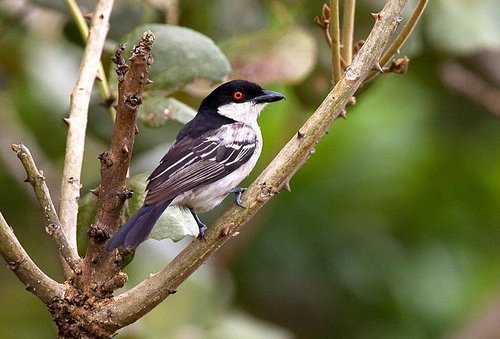
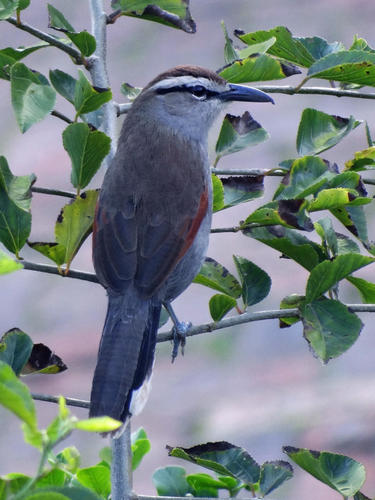
The southern tchagra, with the scientific name Tchagra tchagra (Vieillot, 1816), measures 17–21 cm in total length. It has a brown crown, black eye stripes, and a broad white supercilium separating the eye stripes from the crown. Its underparts are pale grey, while its upperparts are pale brown. When folded, its wings show a chestnut color, and its black tail is tipped with white. Its moderately long bill is black. The sexes of this species have similar appearance. Young southern tchagras are duller than adults, and have a buff stripe running through the eye. Southern tchagra is similar in appearance to the black-crowned tchagra. Black-crowned tchagra is larger than southern tchagra, and adult black-crowned tchagras have a black crown instead of a brown crown, matching their common name. An identification confusion can occur because juvenile black-crowned tchagras have a brown crown. Even so, juvenile black-crowned tchagra can be distinguished from southern tchagra by its larger body size, relatively shorter bill, and paler underparts. There are three subspecies of southern tchagra, all fairly similar to one another. The nominate subspecies T. t. tchagra, found in the Western Cape, has the darkest underparts and the longest bill among the three. T. t. caffrariae has paler underparts and the shortest bill. T. t. natalensis, found in eastern South Africa and Eswatini, has the palest underparts and a reddish-brown crown. The male southern tchagra produces a descending whistling song transcribed as ttttrtr te te te teuuu, given either during its display flight or while it is perched on a spot. The female responds with a trilled call transcribed as tzerrrrrrrr.