About Taxus floridana Nutt. ex Chapm.
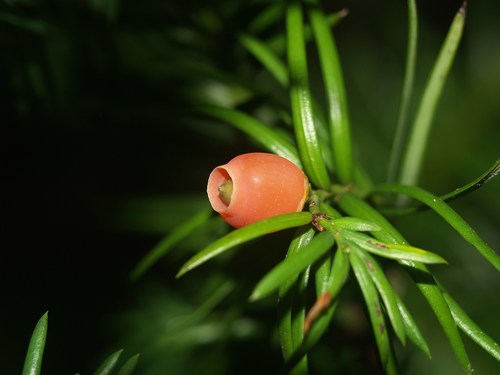
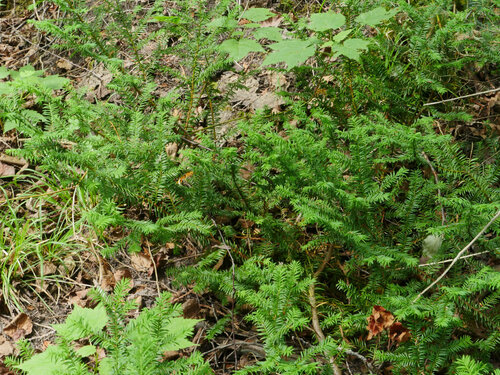
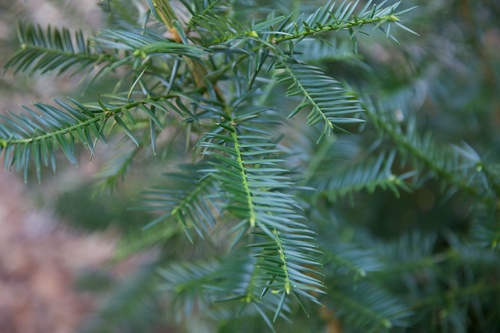
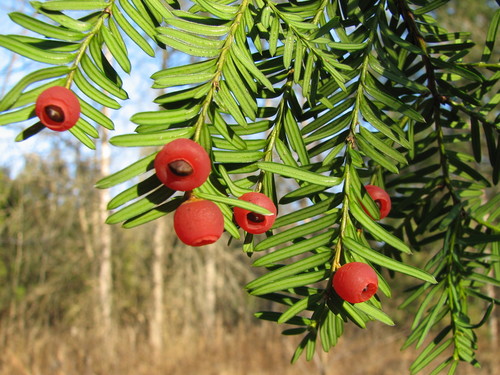
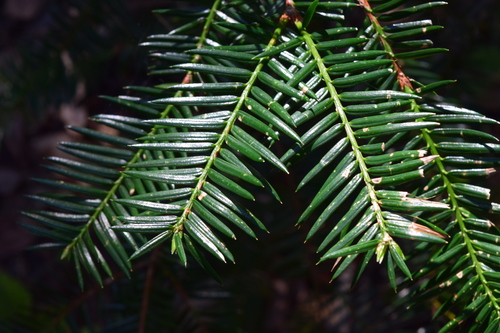
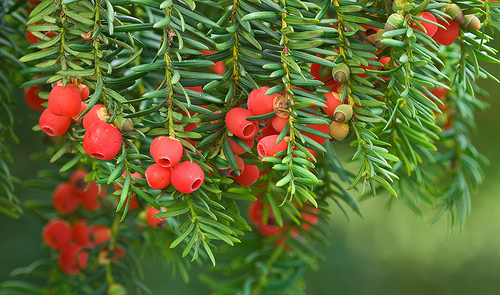
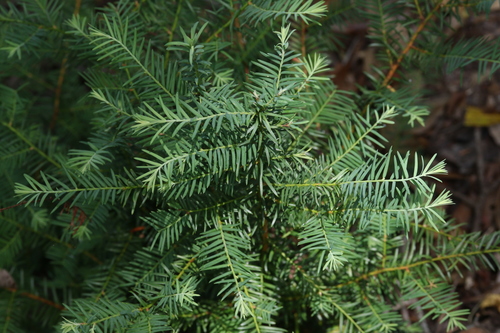
Taxus floridana Nutt. ex Chapm. is an evergreen coniferous species that grows as a shrub or small tree, reaching up to 6 meters tall, and rarely reaching 10 meters. It has a trunk that can grow up to 38 centimeters in diameter. Its bark is thin, scaly, and purple-brown, and its branches grow in irregular orientations. New shoots are green initially, and turn brown after three or four years. The leaves are thin, flat, and slightly sickle-shaped (falcate), measuring 1–2.9 cm long and 1–2 mm broad, with a bluntly acute apex. Leaves are arranged spirally on shoots, but are twisted at the base to form two horizontal ranks, except on erect lead shoots. Most individuals grow in clumps, are multi-stemmed, and have variable stem densities. This species is dioecious, meaning male and female cones grow on separate plants. Seed cones are highly modified and berry-like: a single scale develops into a soft, juicy red aril 1 cm in diameter, which holds a single dark brown seed 5–6 mm long. These seed cones grow singly in just a few leaf axils. Pollen cones are globose, 4 mm in diameter, and are produced on the undersides of shoots in early spring. It grows in the same region as the also rare Torreya taxifolia, and is similar in overall appearance. It can be told apart from T. taxifolia by its shorter, blunt-tipped leaves rather than spine-tipped leaves, and by the weaker scent of its crushed leaves. It is harder to distinguish from other yew species, and like most yews, it has sometimes been classified as a subspecies of Taxus baccata, under the name T. baccata subsp. floridana (Nutt. ex Chapm.) Pilger. A 2021 report from the Morton Arboretum in northern Illinois notes that three species of Taxus (yew) are native to the United States. While they are notoriously hard to tell apart visually, their native distributions do not overlap, so they can be easily distinguished by geography. In ecology, Taxus floridana grows slowly, and prefers slightly acidic, well-drained soil and partial shade. It is highly sensitive to fire, and is also shade tolerant. Variation in soil, slope aspect, and moisture may influence the species' distribution. No indicator species are associated with this yew. It is hardy to USDA zone 8. It can be propagated from cuttings or seeds, and seed scarification is required for germination. It persists naturally through layering and sprouting. Birds feed on its cones, and excavate its stems to access insects. For uses, the bark of Taxus floridana contains paclitaxel, a mitotic inhibitor used to treat many forms of cancer. This compound is also known as Taxol, though new research suggests Taxol is actually produced by a fungus that lives on the Florida yew. The seeds and leaves of this species are poisonous to humans if consumed.