About Taxus canadensis Marshall
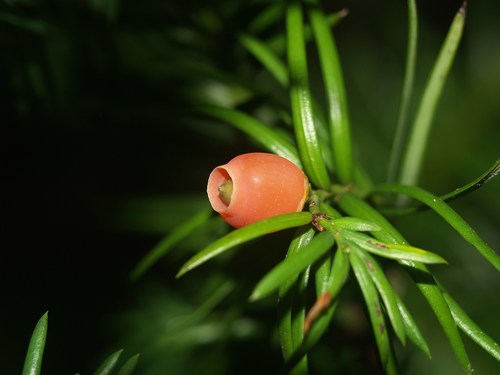
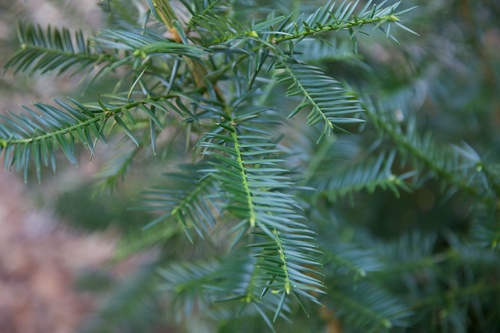
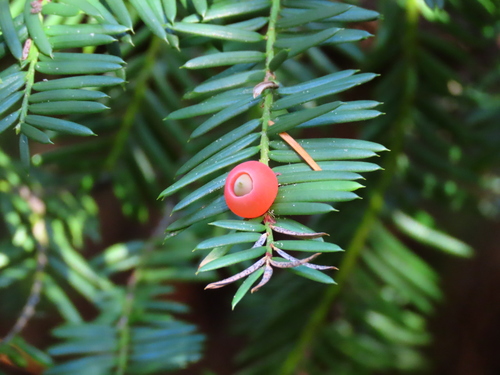
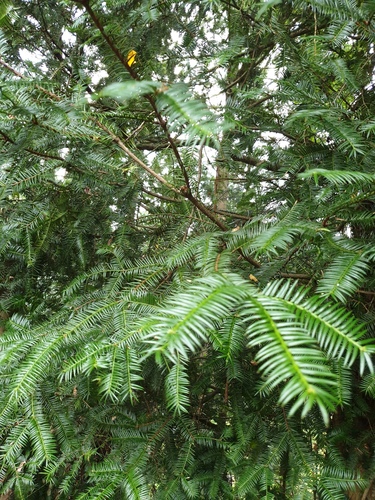
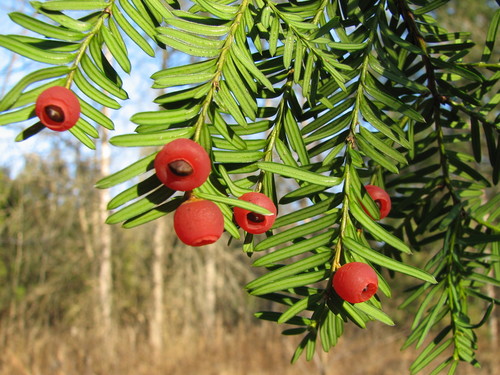
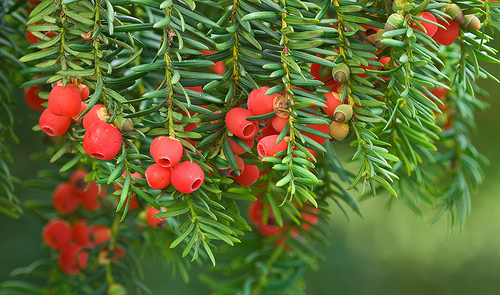
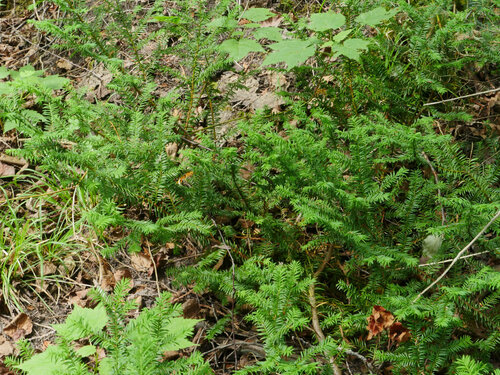
Taxus canadensis Marshall, commonly known as Canadian yew, is typically a low, sprawling shrub that rarely grows taller than 2.5 meters. It occasionally produces strong upright central main stems, but these only develop from the original main stem of a seedling, not from existing spreading branches. The shrub has thin, scaly brown bark. Its leaves, called needles, are lanceolate, flat, and dark green, measuring 1–2.5 cm (3⁄8–1 inch) long and 1–2.4 mm (0.039–0.094 inches) wide. The needles are arranged in two flat rows on opposite sides of the branch. The seed cones of this species are highly modified; each cone holds a single seed that is partially enclosed by a modified scale, which grows into a soft, bright red, berry-like structure called an aril that is open at the end. Thrushes, waxwings, and other birds eat the seeds, and disperse the hard, highly toxic seeds undamaged through their droppings. Male cones are globose and 3 mm in diameter. This species is monoecious, making it one of the few monoecious plants in the Taxus genus. All parts of Canadian yew except the aril are toxic, though it is generally considered less toxic than Taxus baccata. Native Americans living within the plant’s native range used small amounts of yew leaf tea, applied topically or taken internally, to treat a range of ailments, most notably rheumatism. They also used yew twigs in steam baths to help relieve rheumatism symptoms. Modern herbalists generally prefer safer, more effective herbs, due to the plant’s significant toxicity. Canadian yew is harvested in northern Ontario, Québec, and Atlantic Canada because it is a source of taxanes, a class of poisonous chemicals that have been the focus of cancer research. Taxus canadensis is far more abundant than the near-threatened Taxus brevifolia (Pacific yew), and its new growth, called "greens", can be harvested sustainably every five years. This sustainable harvesting method does not require stripping bark, which kills the plant. The most common taxane found in T. canadensis is 9-dihydro-13-acetylbaccatin III, which can be effectively converted into 10-deacetylbaccatin III, a compound used to produce paclitaxel. Two additional taxanes have also been identified in T. canadensis: 7β,10β,13α-triacetoxy-5α-(3'-dimethylamino-3'-phenylpropanoyl)oxy-2α-hydroxy-2(3→20)abeotaxa-4(20),11-dien-9-one, and 2α,10β-diacetoxy-9α-hydroxy-5α-(3'-dimethylamino-3'-phenylpropanoyl)oxy-3,11-cyclotax-4(20)-en-13-one.