About Taxus brevifolia Nutt.
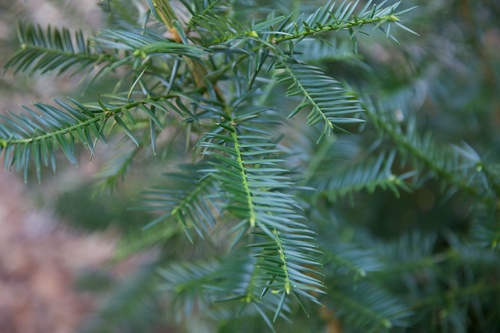
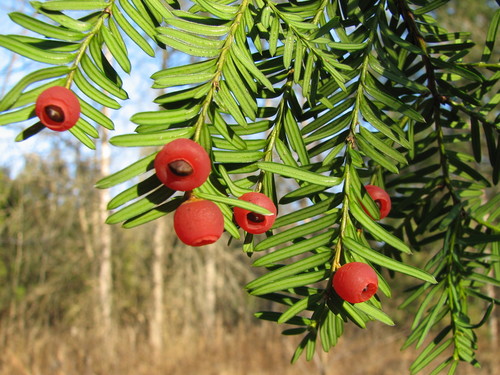
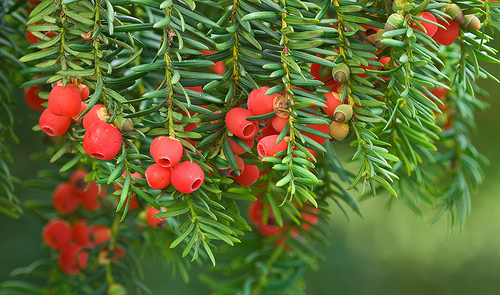
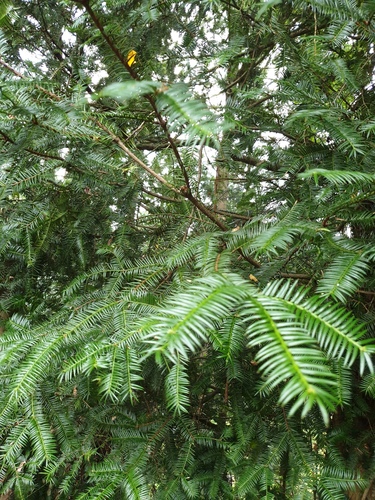
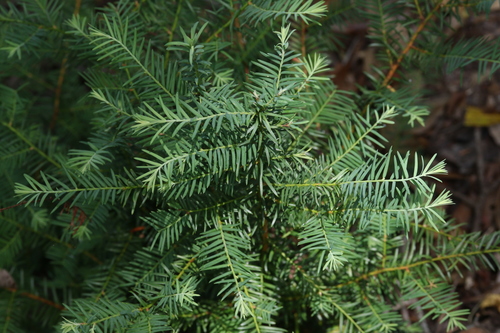
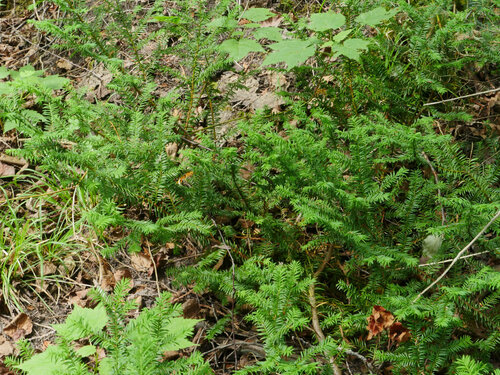
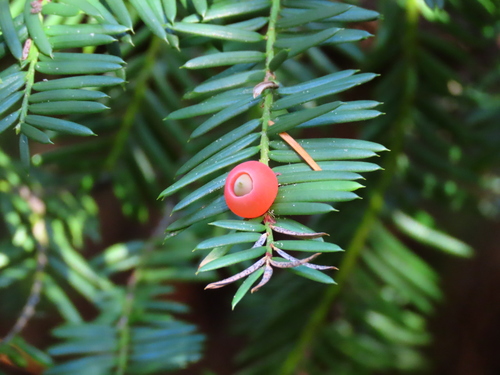
Taxus brevifolia Nutt., commonly known as Pacific yew, is a small evergreen conifer that sometimes takes a shrub form. It typically grows 10–15 metres (33–49 feet) tall, with a trunk up to 50 centimetres (20 inches) in diameter; larger specimens over 20 m (66 ft) tall are rare, and are most often found in protected areas like parks, frequently in gullies. This tree grows extremely slowly, and often rots from the inside out to create hollow trunks. This hollowing makes accurate ring counting to determine a specimen’s true age difficult, and sometimes impossible. It is often damaged by forest succession, and usually develops a short, multi-leader growth form. It can grow new sprouts from decapitated stumps. In its shorter shrub form, sometimes called "yew brush", it can reproduce vegetatively via layering. Its bark is thin and scaly, starting red and turning purplish-brown, and covers a thin layer of off-white sapwood. The inner heartwood is darker, ranging in color from brown to purplish to deep red, and can even be bright orange when freshly cut. Its leaves are flat, lanceolate, and dark green. They measure 1–3 cm (3⁄8–1+3⁄16 in) long and 2–3 millimetres (3⁄32–1⁄8 in) broad, and are arranged spirally on the stem. Leaf bases twist to align the leaves into two flat rows on either side of the stem, though the spiral arrangement remains more visible on erect leading shoots. Its seed cones are highly modified: each cone holds a single 4–7 mm (3⁄16–1⁄4 in) long seed, which is partly surrounded by a modified scale that develops into a soft, bright red, berry-like structure called an aril. The aril is 8–15 mm (5⁄16–9⁄16 in) long and wide, and open at its end. Arils mature 6–9 months after pollination, and aril maturation is spread out over 2–3 months to increase the chance of successful seed dispersal. Thrushes and other birds eat the seeds inside the arils, and disperse the undamaged hard seeds through their droppings. Male cones are globose, 3–6 mm (1⁄8–1⁄4 in) in diameter, and shed their pollen in early spring. Pacific yew is mostly dioecious, but occasional individuals can be variably monoecious, or even change sex over time. Pacific yew is native to the Pacific Northwest of North America. Its range extends from the southernmost point of Alaska south to Northern California, and it occurs mostly in the Pacific Coast Ranges. Isolated disjunct populations are also found in southeast British Columbia and Northern Idaho. It can grow in a wide variety of environments; in drier areas it is mostly limited to streamside habitats, while in moist environments it can grow up onto slopes and ridgetops, reaching altitudes of at least 1,400 metres (4,600 ft) above sea level. It is shade tolerant, but can also grow in full sun. Its shade tolerance lets it grow as an understory tree, and when growing along streams it provides shade that helps maintain cool water temperatures. In terms of ecology, birds eat the aril fruit cups and spread the tree’s seeds, and moose feed on Pacific yew during winter in Rocky Mountain forests. Many parts of the Pacific yew are poisonous, and consumption can be fatal. This includes the seed, which should not even be chewed. The leaves, bark, and seed are all extremely poisonous and should never be consumed. The only edible part is the juicy red aril surrounding the seed, with a mild flavor like cherry jello; it is described as sweet with a slimy texture, though the toxic seed inside must not be eaten. Traditionally, Native Americans used Pacific yew’s resilient, rot-resistant wood to make a variety of items including tools, sinew-backed bows, arrows, and canoe paddles. Other traditional uses included harpoons, fishhooks, wedges, clubs, spoons, drums, snowshoes, and arrowheads. Foliage and bark were used for medicinal purposes. The Pit River Tribe sold this plant to the Ukiah, and the Concow tribe calls the tree yōl'-kō in the Konkow language. Modern longbow makers note that only a very small percentage of Pacific yew trees have grain suitable for making longbows. Japanese craftspeople have used its wood for decoration, and it is also valued in Taiwan. The chemotherapy drug paclitaxel (taxol), used to treat breast, ovarian, and lung cancer, can be derived from Taxus brevifolia and other yew species. When paclitaxel’s chemotherapeutic use was discovered around the 1990s, Pacific yew was already becoming scarce, so it was never commercially harvested from wild habitats at a large scale. Widespread use of paclitaxel became possible around 2003, when a semi-synthetic production pathway was developed using extracts from cultivated yews of other species.