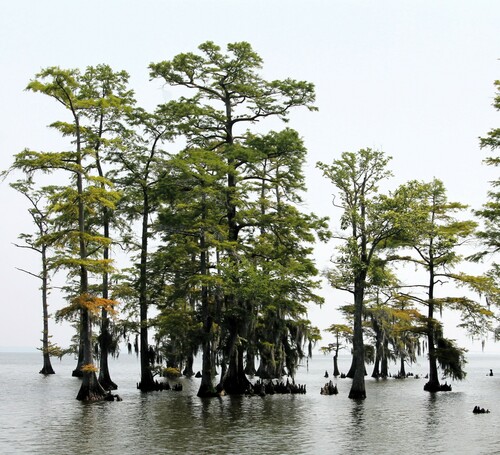
About Taxodium distichum (L.) Rich.
Taxodium distichum (L.) Rich., commonly called bald cypress, is a large, slow-growing, long-lived tree. It typically reaches heights of 10–40 m (35–120 feet) and has a trunk diameter of 0.9–2.1 m (3–7 feet). The main trunk is often surrounded by cypress knees. Its bark is grayish brown to reddish brown, thin, fibrous with a stringy texture, and marked by a vertically interwoven pattern of shallow ridges and narrow furrows. Its needle-like leaves are 1.3 to 1.9 cm (1⁄2 to 3⁄4 inch) long; they are simple, alternate, green, linear with entire margins, and turn yellow or copper red in autumn, as the bald cypress is a deciduous species. This species is monoecious, meaning male and female cones grow on a single plant, forming on slender, tassel-like structures near the edge of branchlets. Cones are produced in April, and seeds ripen in October. Male and female strobili develop from buds formed in late autumn, with pollination occurring in early winter, and mature in approximately 12 months. Male cones grow on 10–13 cm (4–5 inch) long panicles. Young female cones are round, resinous, and green, hardening and turning brown as they mature. Mature female cones are globose, 2.0–3.5 cm (3⁄4–1+3⁄8 inch) in diameter, and hold 20 to 30 spirally arranged, four-sided scales. Each scale bears one, two, or rarely three triangular seeds, and each whole cone contains 20 to 40 large seeds. Cones disintegrate at maturity to release their seeds. Seeds are 5–10 mm (3⁄16–13⁄32 inch) long, the largest of any species in Cupressaceae. Seeds are produced every year, with heavy seed crops occurring every 3–5 years. Seedlings have three to nine cotyledons each, most commonly six. Bald cypress grows in full sunlight to partial shade; it grows best in wet or well-drained soil, but can tolerate dry soil. It has moderate tolerance to salt water aerosols, grows well in acid, neutral, and alkaline soils across all texture classes from light sandy to heavy clay, can grow in saline soils, and tolerates atmospheric pollution. The cones are often eaten by wildlife. The tallest known specimen, located near Williamsburg, Virginia, is 44.11 m (145 ft) tall. The stoutest known specimen, in Real County near Leakey, Texas, has a circumference of 475 in (39 ft). The National Champion Bald Cypress, recognized as the largest member of the species in the United States and listed on the National Register of Champion Trees by American Forest, grows in Cat Island National Wildlife Refuge near St. Francisville, Louisiana. It is 29 m (96 feet) tall, has a 17 m (56 feet) circumference, and is estimated to be approximately 1,500 years old. The oldest known living specimen, found along North Carolina’s Black River, is at least 2,624 years old, making it the oldest living tree in eastern North America. The Senator, a bald cypress in Longwood, Florida, stood 50 m (165 feet) tall before the 1925 hurricane, which removed around 12 m (40 feet) of its height. It had a 14 m (47 feet) circumference, 5.3 m (17.5 feet) diameter, and was estimated to be 3,500 years old before it was accidentally burned down in 2012. The native range of bald cypress extends from southeastern New Jersey south to Florida, west to Central Texas and southeastern Oklahoma, and inland up the Mississippi River to the southernmost parts of Illinois and Indiana. Ancient bald cypress forests, with some trees over 1,700 years old, once dominated Southeast U.S. swamps. Researchers originally thought the native range only reached as far north as Delaware, but have now found a natural forest on the Cape May Peninsula in southern New Jersey. The species also grows outside its native range in New York and Pennsylvania. The largest remaining old-growth stands are located at Corkscrew Swamp Sanctuary near Naples, Florida, and in the Three Sisters tract along eastern North Carolina’s Black River. Corkscrew Swamp’s trees are around 500 years old, and some exceed 40 m (130 ft) in height. In 1985, a dendrochronologist from the University of Arkansas cored trees at the Black River site and found some began growing as early as 364 AD. A 2019 return visit found a tree dated by tree-ring count to 605 BC, ranking it the ninth-oldest tree in the world. In 2012, scuba divers discovered an underwater bald cypress forest several miles off the coast of Mobile, Alabama, in 60 feet of water. Trees in this forest could not be dated via radiocarbon methods, indicating they are more than 50,000 years old, and most likely lived during the early glacial interval of the last ice age. The forest is well preserved, and cut samples still smell like fresh cypress. A team that has not yet published peer-reviewed results is studying the site; one hypothesis is that Hurricane Katrina exposed the grove, which had been protected under ocean floor sediment. Bald cypress is monoecious. Male and female strobili mature in one growing season from buds formed the previous year. Male catkins are about 2 mm (0.079 in) in diameter, borne in slender, purplish, drooping clusters 7 to 13 cm (2+3⁄4 to 5 in) long that are visible during winter on this deciduous conifer. Pollen is shed in March and April. Female conelets grow singly or in clusters of two or three. Globose cones turn from green to brownish-purple as they mature between October and December. They are 13 to 36 mm (0.51 to 1.42 in) in diameter and consist of 9 to 15 four-sided scales that break away irregularly after maturity. Each scale can hold two (rarely three) irregular, triangular seeds with thick, horny, warty coats and projecting flanges. The number of seeds per cone averages 16, and ranges from 2 to 34. Cleaned seeds number between approximately 5,600 to 18,430 per kilogram (2,540 to 8,360 per pound). Bald cypress is one of the few conifer species that can reproduce vegetatively via sprouting. Vigorous sprouts generally grow from stumps of young trees, but trees up to 60 years old will also produce healthy sprouts if cut during fall or winter. However, sprout survival is often poor, and surviving sprouts are usually poorly shaped and do not produce high-quality saw timber. Stumps of trees up to 200 years old may also sprout, but the sprouts are less vigorous and more prone to wind damage as the stump decays. Successful vegetative propagation from cuttings has been recorded when cuttings were not wounded, treated with 15,000 mg/L of Indole-3-butyric acid, and grown in a substrate with intermediate water-holding capacity. Bald cypress seeds remain viable for less than one year, and are dispersed in two ways: first by water, as seeds float and move with water until flooding recedes or the cone is deposited on shore; and second by wildlife, as squirrels eat seeds but often drop some scales from harvested cones. Seeds do not germinate under water, and rarely germinate on well-drained soils; seedlings normally establish on continuously saturated (but not flooded) soils for one to three months. After germination, seedlings must grow quickly to escape floodwaters; they often reach a height of 20–75 cm (up to 100 cm in fertilized nursery conditions) in their first year. Seedlings die if inundated for more than about two to four weeks, so natural regeneration does not occur on sites that are constantly flooded during the growing season. Although vigorous saplings and stump sprouts can produce viable seed, most specimens do not produce seed until they are about 30 years old. In good conditions, bald cypress grows fairly fast when young, then slows growth with age. Measurements show trees can reach 3 m (9.8 ft) in five years, 21 m (69 ft) in 41 years, and 36 m (118 ft) in 96 years; height growth largely stops by the time trees are 200 years old. Some individuals can live over 1,000 years. Determining the age of old bald cypress can be difficult, because variable and stressful growing environments often cause missing or false stemwood rings. Bald cypress trees growing in swamps develop a unique growth feature called cypress knees: woody projections from the root system that grow above ground or water. Their function was once thought to be providing oxygen to roots growing in the low dissolved oxygen water typical of swamps, similar to mangroves. However, there is little evidence for this function; roots of swamp-dwelling specimens that have had their knees removed do not lose oxygen content, and the trees continue to thrive. A more likely function is structural support and stabilization. Bald cypress growing on flood-prone sites tend to form buttressed bases, while trees grown on drier sites often lack this feature. The buttressed base usually starts at the soil surface and extends up to the maximum annual flooding elevation. Buttressed bases and a strong, intertwined root system allow the trees to resist very strong winds; even hurricanes rarely overturn them. Many agents can damage Taxodium distichum. The main damaging, and sometimes lethal, agent is the fungus Lauriliella taxodii, which causes a brown pocket rot called “pecky cypress”. This fungus attacks the heartwood of living trees, usually from the crown down to the roots. A few other fungi attack the sapwood and heartwood, but they do not usually cause serious damage. Insects including the cypress flea beetle (Systena marginalis) and the bald cypress leafroller (Archips goyerana) can seriously damage trees by destroying leaves, cones, or bark. Nutrias also clip and unroot young bald cypress seedlings, sometimes killing an entire plantation in a short time. In 2002, the Indiana Department of Natural Resources listed Taxodium distichum as a state-protected Threatened plant. Globally, the IUCN lists the species as Least Concern. In the United States, bald cypress is hardy and can be planted in hardiness zones 4 through 10. It is a popular ornamental tree cultivated for its light, feathery foliage and orangey brown to dull red autumn color. In cultivation, it thrives in a wide range of soils, including well-drained sites where it would not grow naturally, because juvenile seedlings cannot compete with other native vegetation there. Cultivation is successful far north of its native range, even reaching southern Canada. It is also commonly planted in Europe, Asia, and other temperate and subtropical regions. It is sometimes planted in gardens and parks in Eastern Australia, with most specimens found in temperate to warm temperate areas. However, two trees are growing well in an open location along a highway drain north of Port Douglas, Queensland, at coordinates -16.4853970, 145.4134609, suggesting the species can grow well in tropical conditions. It does require hot summers for good growth. When planted in locations with the cool summers of oceanic climates, growth is healthy but very slow; some specimens in northeastern England have only reached 4–5 m (13–16 ft) tall in 50 years and do not produce cones. One of the oldest specimens in Europe was planted in the 1900s at the Arboretum de Pézanin in Burgundy, France. An alley of Louisiana cypress trees was planted in the 18th century in the park of the Château de Rambouillet, southwest of Paris. Bald cypress produces great merchantable timber yields. In virgin stands, yields from 112 to 196 cubic meters per hectare were common, and some stands may have exceeded 1,000 cubic meters per hectare.