About Taurotragus oryx (Pallas, 1766)
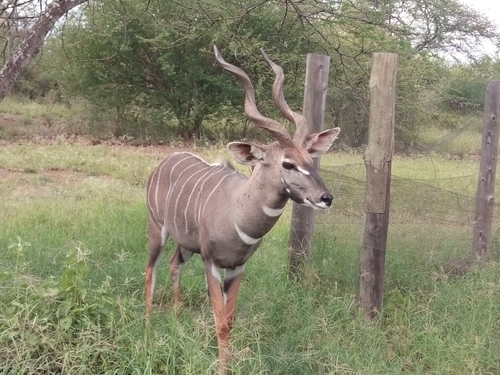
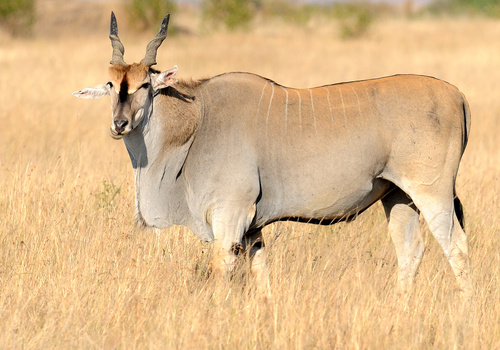
Taurotragus oryx, the common eland, is a spiral-horned antelope that shows clear sexual dimorphism: females are smaller than males. Females weigh 300–600 kg (660–1,320 lb), measure 200–280 cm (79–110 in) from snout to the base of the tail, and stand 125–153 cm (49–60 in) at the shoulder. Bulls weigh 400–942 kg (882–2,077 lb), measure 240–345 cm (94–136 in) from snout to the base of the tail, and stand 150–183 cm (59–72 in) at the shoulder. Male elands can reach up to 1,000 kg (2,200 lb) in weight. The eland’s tail is 50–90 cm (20–35 in) long. Coat markings of common elands vary geographically: elands in the northern part of their range have distinctive markings including torso stripes, leg markings, dark garters, and a spinal crest, which are not present in southern populations. Aside from a rough mane, the eland’s coat is smooth. Females have a tan coat, while males have a darker coat with a bluish-grey tinge. Bulls may also have a series of vertical white stripes on their sides, especially in parts of the Karoo in South Africa. As males age, their coat becomes increasingly grey. Males also have dense fur on their foreheads and a large dewlap on their throats. Both sexes have horns with a steady spiral ridge, similar to that of the bushbuck. Horns appear as small buds in newborns and grow rapidly during the first seven months. Males have thicker, shorter horns with a tighter spiral than females: males’ horns measure 43–66 cm (17–26 in) long, while females’ are 51–69 cm (20–27 in) long. Males use their horns to wrestle and butt heads with rivals during rutting season, while females use their horns to protect their young from predators. The common eland is the slowest antelope, with a peak speed of 40 km/h (25 mph) that tires them quickly. However, they can trot indefinitely at 22 km/h (14 mph). When startled, common elands can jump up to 2.5 m (8 ft 2 in) from a standing start; young elands can jump up to 3 m (9.8 ft). The common eland’s general life expectancy is between 15 and 20 years, and some individuals in captivity live up to 25 years. Eland herds produce a noticeable loud clicking sound that has been the subject of much speculation. A leading hypothesis holds that the animal’s weight causes the two halves of its hooves to splay apart, and the clicking sound comes from the hoof snapping back together when the leg is raised. The sound travels some distance from the herd, and may function as a form of communication. Common elands inhabit the open plains of Southern Africa and the foothills of the great southern African plateau. Their range extends north into Ethiopia and most arid zones of South Sudan, west into eastern Angola and Namibia, and south to South Africa. Poaching and human settlement have resulted in a low overall population density of elands across Africa. Elands prefer semiarid areas with abundant shrub-like bushes, and commonly inhabit grasslands, woodlands, subdesert, bush, and mountaintops up to around 4,600 m (15,000 ft) in altitude. They avoid forests, swamps, and deserts. The habitats they occupy generally contain Acacia, Combretum, Commiphora, Diospyros, Grewia, Rhus, and Ziziphus trees and shrubs, some of which are used as food. Today, common elands are present in many African national parks and reserves, including Nairobi National Park, Tsavo East National Park, Tsavo West National Park, and Masai Mara National Reserve in Kenya; Serengeti National Park, Ruaha National Park, Tarangire National Park, and Ngorongoro Crater in Tanzania; Kagera National Park in Rwanda; Nyika National Park in Malawi; Lake Mburo National Park and Kidepo Valley National Park in Uganda; Luangwa Valley and Kafue National Park in Zambia; Hwange National Park, Matobo National Park, Tuli Safari Area, and Chimanimani Eland Sanctuary in Zimbabwe; and Kruger National Park, Kgalagadi Transfrontier Park, Giant's Castle, and Suikerbosrand NR in South Africa. Home ranges for female and juvenile elands measure 200–400 km², while male home ranges are around 50 km². Common elands are nomadic and crepuscular. They feed during the morning and evening, rest in shade when it is hot, and stay in sunlight when it is cold. They are commonly found in herds of up to 500 individuals, with individual members staying in the herd from several hours to several months. Mothers and juveniles tend to form larger herds, while males may separate into smaller groups or wander alone. Group formation happens more regularly during estrus, which occurs mainly in the rainy season. In Southern Africa, common elands often associate with herds of zebras, roan antelopes, and oryxes. Common elands communicate through gestures, vocalizations, scent cues, and display behaviors. They also perform the flehmen response, primarily in males when they contact female urine or genitals. Females urinate to signal fertility during their receptive estrus phase, and to signal a lack of fertility when harassed by males. If bull elands detect nearby predators, they bark and trot back and forth to alert other herd members until the entire herd is aware of the danger. Their main predators include lions, African wild dogs, cheetahs, and spotted hyenas, and eland calves are more vulnerable to predation than adult elands. Females reach sexual maturity at 15 to 36 months, while males reach sexual maturity at 4 to 5 years. Mating can occur any time after sexual maturity, but it is most common during the rainy season. In Zambia, young are born in July and August, while this is the mating season for elands elsewhere. Mating begins when elands gather to feed on lush green plains with plentiful grass, and individual pairs of males and females mate. Males chase females and test their urine to check if they are in estrus. Females usually choose the most dominant and fit male to mate with. Sometimes females run away from males attempting to mate, which increases the males’ attraction to her, leading to fights between males that use their hard horns. A female allows a male to mount after two to four hours. Males typically stay in close contact with females during the mating period, and a dominant male can mate with more than one female. Females have a nine-month gestation period, and give birth to only one calf each time. Males, females, and juveniles each form separate social groups. Male groups are the smallest, and members stay together to search for food or water sources. Female groups are much larger and cover greater areas; they travel across grassy plains during wet periods and prefer bushy areas during dry periods. Females have a complex linear hierarchy. A nursery and juvenile group forms naturally when females give birth. Around 24 hours after delivery, the mother joins the female group, leaving the calf to join the nursery group where calves socialize with one another. Calves leave the nursery group when they are at least two years old, then join an adult male or female group. The common eland is sometimes farmed and hunted for its meat. In some cases it can be a better livestock option than cattle because it is better adapted to African climates, leading some Southern African farmers to switch from raising cattle to raising eland. The common eland also appears as a supporter in the coat of arms of Grootfontein, Namibia.