About Tauraco persa (Linnaeus, 1758)
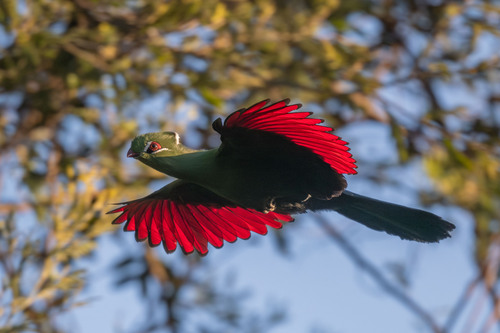
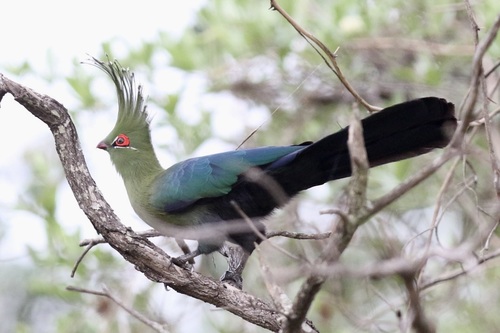
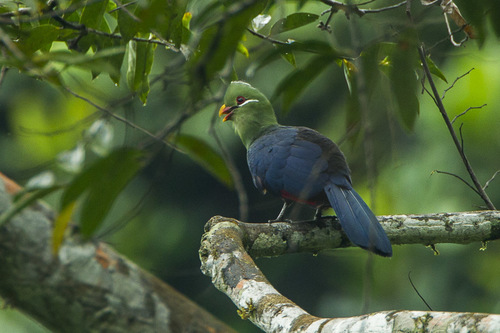
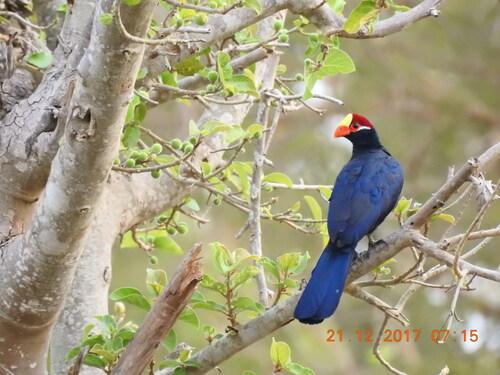
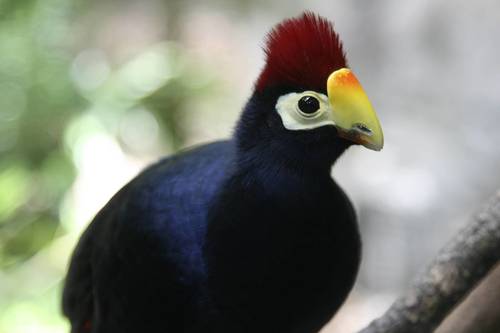
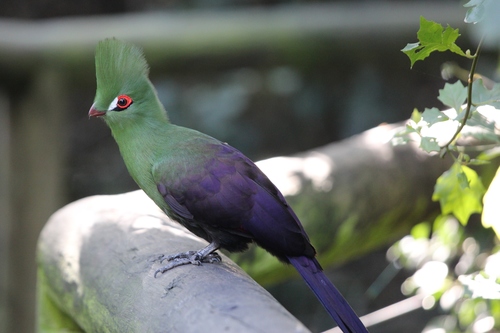
The Guinea turaco (Tauraco persa), scientific name Tauraco persa (Linnaeus, 1758), is often inconspicuous when staying in treetops. It measures approximately 40–43 cm (16–17 in) in total length including its long tail, and weighs between 225–290 g (7.9–10.2 oz). Its plumage is mostly brilliant green and blue; the green coloration comes from the pigment turacoverdin. The tail and wings are dark purplish, except for distinct crimson primary feathers that stand out clearly when the bird is in flight. It has an erectile semi-circular green crest on its head, red and white patches around its eyes, and a thick red bill. In the westernmost subspecies Tauraco persa buffoni, which is sometimes called Buffon's turaco, there is a white line above and in front of the eye, and a black line below the eye. In the nominate subspecies Tauraco persa persa from the central part of the species' range, and zenkeri from the southeastern part, there is an additional second white line below the black line. Unlike similar red-billed turaco species, even adult Guinea turacos have no white rear edge on their crest. The Guinea turaco produces a loud cawr-cawr call, made up of 10–16 raucous cawing notes. This species has an extremely large range and a stable population. It occurs in forests of West and Central Africa, ranging east from Senegal to the Democratic Republic of the Congo, and south to northern Angola. It has been recorded in Angola, Benin, Cameroon, the Central African Republic, the Republic of the Congo, the Democratic Republic of the Congo, Equatorial Guinea, Gabon, Gambia, Ghana, Guinea, Guinea-Bissau, Ivory Coast, Liberia, Mali, Nigeria, Senegal, Sierra Leone and Togo. It inhabits subtropical and tropical moist lowland forest, gallery forest, and tropical rainforest edge, and is often found near cultivated areas. It is common in climax forest with abundant tall trees, occurring from sea level up to around 1,100 m (3,600 ft). Tauraco persa is normally sedentary and strongly territorial. These birds feed on a wide variety of wild and cultivated tropical fruits, including species from genera such as Musanga, Macaranga, Rauvolfia, Cissus and Ficus, and also feed on blossoms. They do not fly well, and prefer to climb between branches instead. Breeding timing varies by location: in Cameroon they breed in May–June and August, in Gabon they breed from December to February and from June to September, and in Sierra Leone they breed in June and October. Females lay two eggs in a platform nest built in a tree.