About Tauraco corythaix (Wagler, 1827)
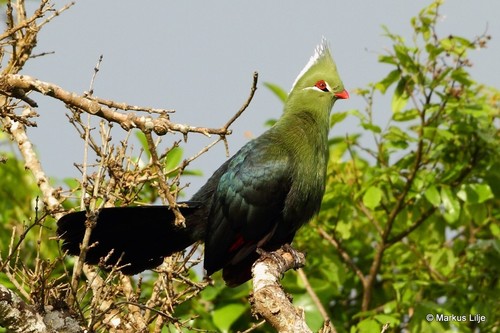
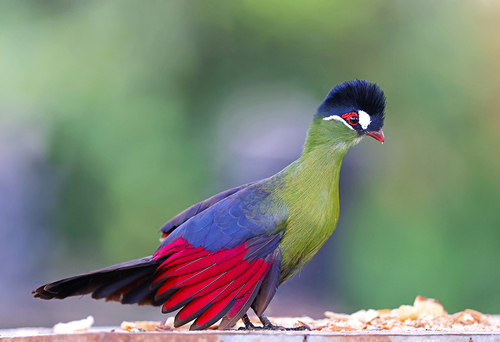
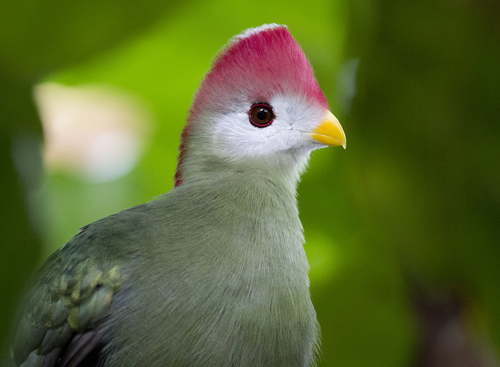
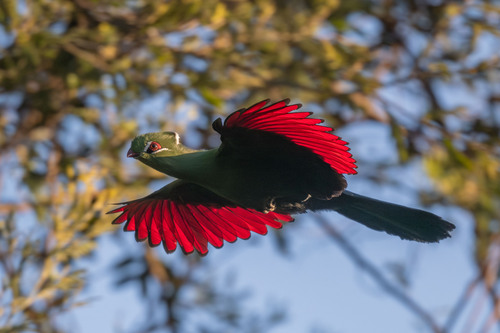
The Knysna turaco, with the scientific name Tauraco corythaix, is called Knysna loerie in South Africa. It is a large turaco, a member of the African Musophagidae bird group. It is a resident breeding bird found in mature evergreen forests of southern and eastern South Africa, as well as Eswatini. Previously, it was sometimes classified as a subspecies of the West African green turaco; historically, both Livingstone's and Schalow's turacos were considered subspecies of this species. This species lays two eggs in a shallow stick platform nest, which is positioned in a tree or a clump of creepers. Within its range, it is an unmistakable bird, though it often stays inconspicuous in the treetops. It measures 40 to 42 cm long, including its long tail. Its small but thick orange-red bill and a white line just below the eye stand out against its mainly green plumage. It has a tall green crest tipped with white. Its eye is brown, and its eye-ring is deep red. When in flight, the Knysna turaco displays prominent crimson primary flight feathers. Males and females are similar in appearance, while juvenile birds have a shorter crest that lacks the white tip. The Knysna turaco is most often observed flying between forest trees or hopping along branches. Its diet consists of fruit, insects, and earthworms. It produces a loud kow-kow-kow-kow call. Members of this bird family are called loeries in South Africa, while the international common name is turaco. Turacos (10 species in the genus Tauraco and 2 species in the genus Musophaga) are the only birds that have true red and green color. For most other bird species, the plumage color human eyes see is structural color produced by feather structure. Turacos' red pigment (turacin) and green pigment (turacoverdin) both contain copper. If you stir a glass of water with a red turaco feather, the water will turn pink. In museum specimens, these pigments darken with age as the copper oxidizes. These birds retain their colors year-round. It is thought that the Knysna loerie uses its red wing feathers to escape predators. When it flies, predators tend to focus on the most visible red patch, follow it, and when the bird lands and folds its wings, the red wing feathers become hidden, allowing the Knysna loerie to escape unseen.