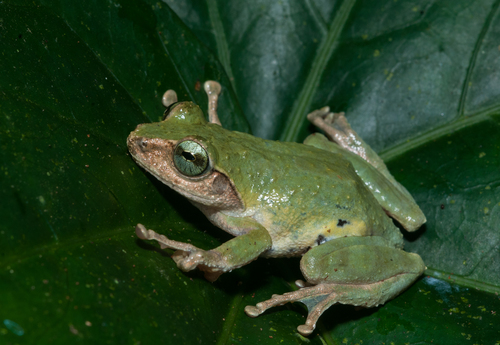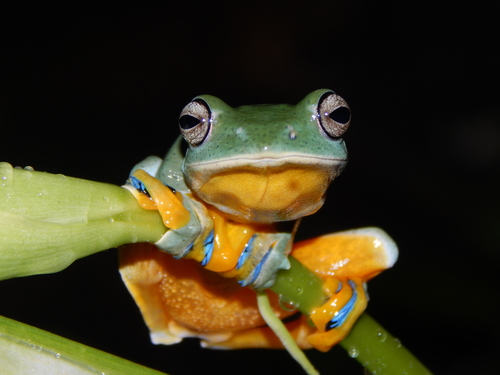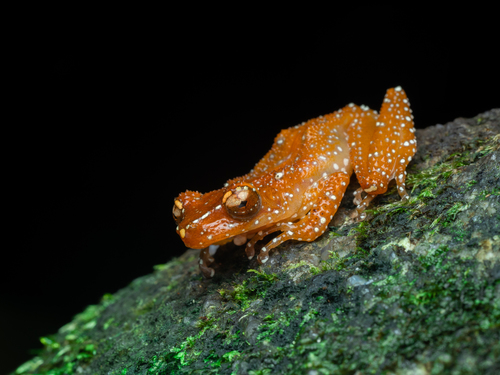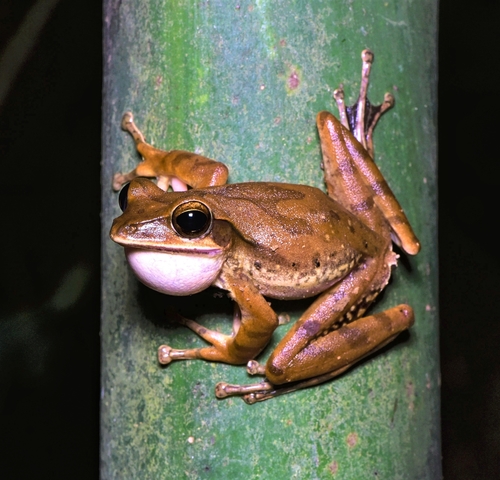
About Taruga eques (Günther, 1858)
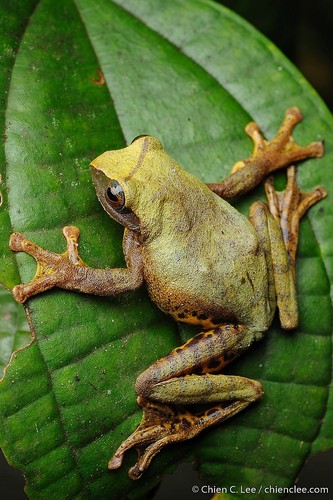
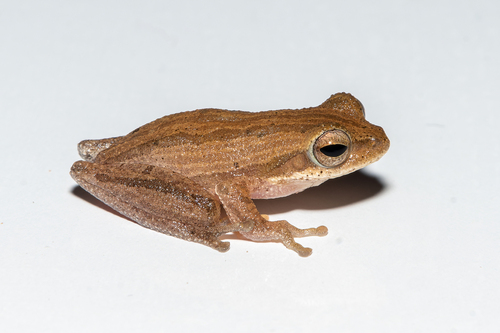
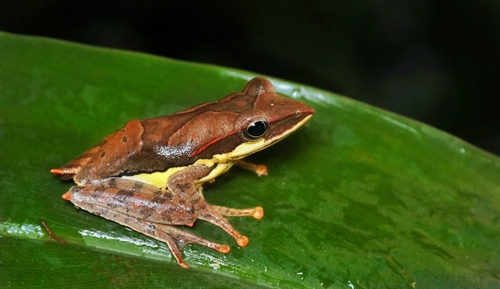
Taruga eques is a large frog species. Adult males measure 33–43 mm (1.3–1.7 in) in snout–vent length, while adult females measure 59–71 mm (2.3–2.8 in). This species has a long, sharp, triangular snout: female snouts are red-orange, and male snouts are typically brown. The underside of the snout ranges from grey to cream-yellow. The pattern on the back varies between an hourglass shape and brown spots, and the hind legs bear dark stripes. Taruga eques resembles and has often been confused with Taruga fastigo, but it can be distinguished by its relatively shorter legs and narrower, longer head. Additionally, unlike Taruga fastigo, Taruga eques lacks the black line that connects the axilla to the groin; in some individuals, this line is only reduced to a band of blackish dots. It can be differentiated from other members of the genus Polypedates by the presence of a calcar on the heel. Taruga eques inhabits montane tropical moist forests in the central hills of Sri Lanka, at elevations between 1,200 and 2,135 m (3,937–7,005 ft) above sea level. It is both arboreal and terrestrial, found in canopies and on tree trunks, as well as in grasses growing at the edge of ponds. It has been recorded in Horton Plains National Park, Hakgala Strict Nature Reserve, Knuckles Mountain Forest Reserve, and Peak Wilderness Sanctuary. Tadpoles of this species are most often found in both permanent and seasonal ponds. While Taruga eques is commonly encountered within its range in Sri Lanka, the IUCN classifies it as Endangered due to ongoing habitat loss. It does not occur in human-modified habitats, indicating the species cannot tolerate human impacts to its environment. Knuckles Mountain Forest Reserve, one of the species' confirmed habitats, is currently threatened by tea and cardamom plantations, unregulated construction, tourism, man-made forest fires, and invasive species. Additional potential threats include reduced rainfall from climate change, subcutaneous parasitic infections, and forest dieback. The species' reliance on microhabitats associated with Juncus effusus and its ecological specialization are also considered factors that increase its existential risk. During the daytime, Taruga eques uses Juncus effusus and other herbs as shelter to avoid desiccation. Observations show that individuals typically begin emerging in mid-afternoon and vocalize until approximately midnight. This species favors humid environments with humidity over 65% and temperatures below 16 °C, and prefers still bodies of water with temperatures lower than 16.5 °C. Known predators of Taruga eques include the Indian Pond Heron, Indian Black Bird, mongooses, dragonfly larvae, and the Eurasian Otter. This species is parasitized by cestodes and leeches. It occurs in sympatry with Fejevarya greenii, Pseudophilautus microtampanioum, Pseudophilautus alto, and multiple other species in the genus Pseudophilautus.