About Taricha torosa (Rathke, 1833)
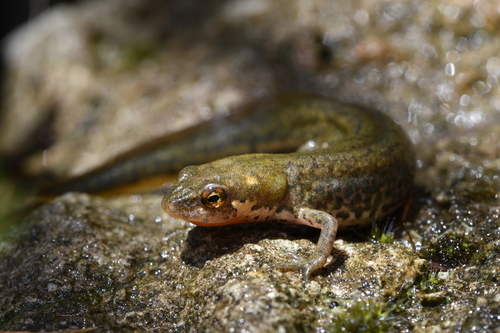
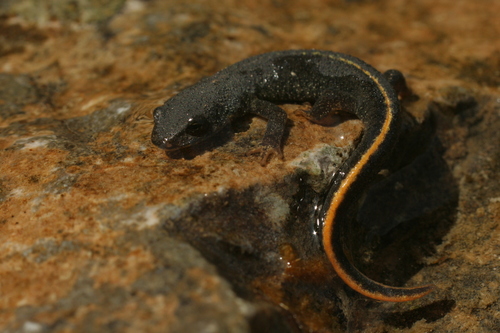
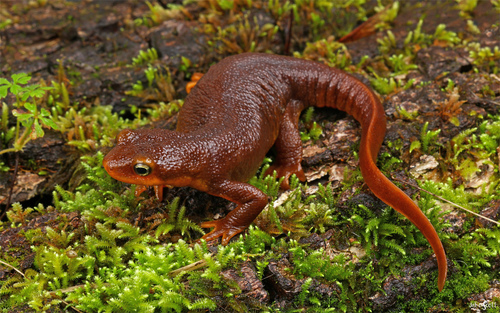
Description: The California newt (Taricha torosa) has warty, slate-gray skin on its back and bright orange-yellow skin on its underbelly. It looks very similar to the rough-skinned newt, and the two are often indistinguishable without dissection. In general, though, the California newt has orange skin around the bottom of its eye, while the rough-skinned newt has gray skin at the bottom of its eye. Additionally, when viewed from above, the California newt's eyes protrude beyond the edge of the jaw line (the rough-skinned newt's eyes do not protrude), which gives the California newt's head a more bullet-like appearance. The red-bellied newt is also similar in appearance, but differs in several ways: it has dark irises (the California newt has yellow irises), more red coloration on its underbelly, and a dark band across the vent that the California newt lacks. Newts are amphibians related to salamanders, and belong to the subfamily Pleurodelinae. They live in North America, Europe and Asia, and their skin is typically rougher than salamanders' skin. Range and habitat: California newts live in the coastal counties of California, as well as the southern and central Sierra Nevada. They occupy a diverse range of habitats near the small ponds and creeks where they breed, including woodlands and chaparral. Reproduction: Breeding generally occurs between December and early May. Typically, adult newts return to the pool where they hatched to breed. After a mating dance, the male mounts the female and rubs his chin on her nose. He then attaches a spermatophore to the substrate, which the female retrieves into her cloaca. The female's egg mass contains between 7 and 30 eggs, and has a consistency similar to thick gelatin dessert. Egg masses are typically attached to stream plant roots or rocky crevices in slow-moving small pools, but can also attach to underwater rocks or leaf debris. While these pools are shallow in a broad sense, they are deeper relative to the average depth of a Southern California stream, ranging from about 1 to 2 metres (3.3 to 6.6 ft) deep. Most adult newts leave the pools shortly after breeding finishes, but some adults may stay in the pools for a few extra months to feed. Larvae hatch from early to midsummer, depending on local water temperature. Larvae are hard to find in streams because they blend in well with the sandy bottom that they usually stay close to. The size of a mother's eggs influences the size of the larvae: larvae from larger eggs not only have a shorter metamorphosis period than larvae from smaller eggs, but also grow to be larger. Toxicity and predation: Like other members of the genus Taricha, skin glands of Taricha torosa secrete the potent neurotoxin tetrodotoxin, which is hundreds of times more toxic than cyanide. This is the same toxin found in pufferfish and harlequin frogs. Researchers believe that bacteria synthesize tetrodotoxin, and animals that use this neurotoxin get it by eating these bacteria. This neurotoxin is strong enough to kill most vertebrates, including humans. Due to their toxicity, California newts have few natural predators. Garter snakes are the most common predator, and some garter snake species have developed genetic resistance to tetrodotoxin. Gene mutations that give snakes resistance to the toxin have created selective pressure that favors newts that produce higher levels of toxin. Increases in newt toxin levels then create selective pressure that favors snakes with mutations that give even greater resistance. This evolutionary arms race has resulted in newts producing toxin levels far higher than what is needed to kill any other typical predator. Taricha torosa also uses the "unken reflex" when responding to predator threats. In this posture, the California newt stretches, flexes the dorsal side of its body, lifts its head and tail into the air, and exposes its brightly colored underbelly. This version of the unken reflex is specific to this species, and differs from that of Taricha granulosa because the California newt's tail stays straight instead of curling.