About Taricha granulosa (Skilton, 1849)
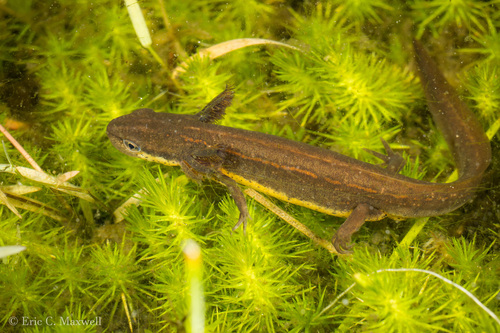
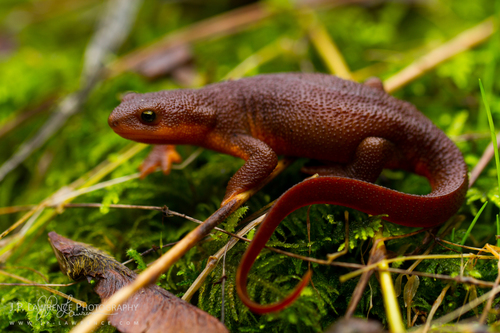
The rough-skinned newt (also called roughskin newt), scientifically Taricha granulosa, is a North American newt recognized for the strong toxin it exudes through its skin. This species is distributed across the Pacific Northwest of North America; its range stretches south to Santa Cruz, California, and north to Alaska. It is uncommon east of the Cascade Mountains, though occasional individuals, thought to be exotic and possibly artificially introduced, have been found as far east as Montana. There is one isolated, most likely introduced population living in several ponds just north of Moscow, Idaho. Multiple subspecies have been proposed based on local population variants, but only two have received wider recognition: the nominate subspecies Taricha granulosa granulosa, and Taricha granulosa mazamae, the Crater Lake newt found at Crater Lake, Oregon. Currently, researchers do not consider Taricha granulosa mazamae a valid subspecies, because specimens matching the description of T. g. mazamae have also been discovered in parts of Alaska. As a defense against predators, many newt species produce toxins in their skin glands, but toxins from newts of the genus Taricha are especially potent. This newt gives off an acrid smell that acts as a warning to keep other animals away. Toxic effects generally only occur if the newt is ingested. However, some people have reported experiencing skin irritation after direct skin contact, especially if they touch their eyes after handling the newt without washing their hands. In 1979, a 29-year-old man from Oregon died after ingesting a rough-skinned newt.