About Tarebia granifera (Lamarck, 1816)
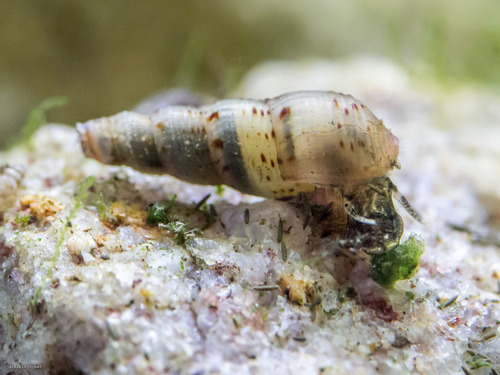
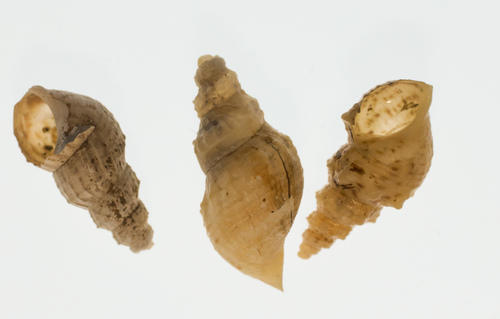
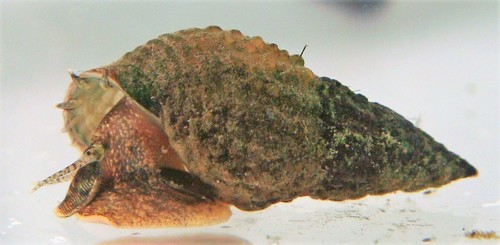
Tarebia granifera (Lamarck, 1816) is a thiarid snail species. In 1952, R. Tucker Abbott published a detailed description of its anatomy, along with notes on its biology and bionomics. Malek provided a dissection guide for the species in 1962. The maximum height of adult shells ranges from 18.5 mm to 25.1 mm for individuals from South Africa, while adults from Puerto Rico can grow as large as 35 mm. This species has two distinct shell color forms: one with a pale brown body whorl and a dark spire, and another that is entirely dark brown to almost black. Intermediate color forms also exist. The native range of Tarebia granifera includes India, Sri Lanka, the Philippines, Hawaii, southern Japan, the Society Islands, Taiwan, Hong Kong, and Thailand. It has become an invasive species on at least three continents: North America, South America, and Africa, and initial introductions are thought to have occurred via the aquarium trade. In the Americas, it is found in Florida, Texas, Hawaii, and Idaho in the United States, multiple Caribbean islands including Puerto Rico, Cuba (where it is one of the most common freshwater snails alongside Physella acuta), the Dominican Republic, Saint Lucia, and Martinique (present there since 1991), as well as Mexico in Central America and El Hatillo Municipality, Miranda in Venezuela. In Africa, it is found in South Africa. It was first recorded in South Africa (and the African continent) in 1999 in northern KwaZulu-Natal, but it was likely introduced before 1996. In the 10 years after its discovery, it spread rapidly, particularly northwards into Mpumalanga province, the Kruger National Park, and Eswatini, and it is expected that its spread will continue into northern South Africa, Mozambique, Zimbabwe, and beyond. The rate of its dispersal cannot currently be calculated. In non-indigenous Asia, it occurs in Israel. In South Africa, Tarebia granifera has colonized a wide variety of habitat types, including natural rivers, lakes, irrigation canals, concrete-lined reservoirs, and ornamental ponds. It can reach very high densities, up to 21 000 individuals per m2, and is thought to have a larger impact on the native benthos of the region's natural waterbodies than any other known invasive freshwater invertebrate. Native South African thiarid snails Thiara amarula, Melanoides tuberculata, and Cleopatra ferruginea are considered especially vulnerable to these impacts. In South Africa, 93% of recorded localities lie below 300 m above sea level, and an estimated 39 500 km2 of area in the region has been colonized. The only known localities outside this low-altitude range are the Umsinduzi River in Pietermaritzburg and its confluence with the Umgeni River, which lie at approximately 500 m altitude. R. Tucker Abbott noted in 1952 that on Guam Island, Tarebia granifera occurred in streams and rivers at 983 m altitude, but these watercourses consistently maintained temperatures above 24 °C, suggesting that temperature is an important factor limiting the species' distribution. Tarebia granifera also lives in several estuaries along the KwaZulu-Natal coast. A dense population of approximately 6038 individuals per m2 has been recorded at Catalina Bay, Lake St Lucia in iSimangaliso Wetland Park, KwaZulu-Natal at a salinity of 9.98‰, equal to 28.5% sea water. These records confirm that Tarebia granifera can colonize brackish and moderately saline habitats and reach high densities there. Observations from Puerto Rico suggest that the snails can survive temporary exposure to saline conditions for several weeks by burying into the substratum, and emerge once fresh water returns. Like other members of the family Thiaridae, Tarebia granifera is primarily a benthic species. In South Africa, it has been collected on a wide range of substrata in both natural and artificial waterbodies, including sand, mud, rock, concrete bridge foundations, and the concrete walls and bottoms of reservoirs, irrigation canals, and ornamental ponds. Many of these habitats are vegetated; associated vegetation includes multiple types of emergent monocotyledons (such as Cyperus papyrus, Scirpus sp., Typha sp., Phragmites sp.) and dicotyledons (such as Ceratophyllum demersum, Potamogeton crispus, Nymphaea nouchali). At high population densities, Tarebia granifera can also be found on marginal, trailing vegetation and the floating common water hyacinth Eichhornia crassipes. It favors turbulent water and tolerates current speeds up to 1.2 m.s−1, and may tolerate even higher speeds. This habitat range matches that recorded for the species in Puerto Rico. Outside of its native range in Asia, the main focus of study on this species is its invasive ability and its impacts on native benthic communities in colonized waterbodies. On a water quality scale from 0 to 10, where 0 is the best water quality and 10 is the worst, Tarebia granifera has a pollution tolerance value of 3. Typically, half or more of a snail population is buried in sediment and not visible from the surface. This burrowing behavior has also been observed in aquaria, where individuals actively bury themselves in sand. The exact proportion of a population that is buried at any given time is unknown, and it is also unknown how long snails can remain buried. In aquaria, Tarebia granifera dies at 7 °C, and in the wild, the species does not live in water temperatures below 10 °C. Tarebia granifera is both parthenogenetic and ovoviviparous, though males of the species have been recorded. These reproductive traits are considered key to its success as an invader. For example, no males have been found among hundreds of dissected individuals from KwaZulu-Natal, but it is thought that a small number may still exist. In 6 out of 7 examined populations from Puerto Rico, males were found, but they were generally uncommon, making up up to 22.7% of the population with a mean of 4.6%. Live sperm was present in the testes of these males, but their genitalia appear to be non-functional. R. Tucker Abbott (1952) failed to find any sperm in the gonads of male Tarebia granifera collected from Florida. This means that almost all Tarebia granifera are clones of the female parent. Embryos develop in a brood pouch, a compartmentalized structure located immediately above the oesophagus that only develops after the snail reaches sexual maturity. The size of the brood pouch increases as the number of embryos it holds grows. A single brood pouch can contain between 1 and 77 embryos. Multiple sources cited by Tucker Abbott (1952), Chaniotis et al. (1980), and WHO (1981) state that females can give birth to one juvenile every 12 hours. Young snails emerge through a birth pore located on the right side of the head. Newborn snails have a shell height of less than 1–2 mm, with between 1.5 and 4.8 whorls, and a total size at birth of 0.7–2.1 mm. According to Chen (2003), newborn snails have a high survival rate in the wild. The onset of sexual maturity in Tarebia granifera is generally indicated by the shell size of the smallest snail observed giving birth, rather than through histological assessment of gonad development. Appleton & Nadasan (2002) estimated that maturity begins at a shell height of 10–12 mm, but unpublished data suggests an onset closer to 8 mm shell height, which aligns with other published studies. Tucker Abbott (1952) estimated sexual maturity at 5.5–8.0 mm at different sites along a short stretch of river in Florida. Chaniotis et al. (1980) reported a similar estimate of 6.0–7.0 mm from a cohort of laboratory-bred snails in Puerto Rico. After extrapolating data from Yong et al. (1987), Ferrer López et al. (1989), and Fernández et al. (1992), Appleton et al. (2009) concluded that sexual maturity is reached at around five months of age. Reported variation in the maturation period ranges from 97 to 143 days (3.2–4.8 months) under laboratory conditions, up to 6–12 months, also based on laboratory data. It is difficult to connect shell size at maturity to age, since the size structure of populations varies over time and between different localities. Dissection of Tarebia granifera has found blastula-stage embryos in the brood pouches of snails as small as 8 mm shell height. Small numbers of shelled embryos, including veligers, are found in snails of 10–14 mm shell height, and become more common in snails larger than 14 mm, especially those over 20 mm. Unshelled embryos in the blastula, gastrula, and trochophore stages are not found in snails larger than 16 mm, and the number of shelled embryos also decreases in the largest snails, which are over 24 mm. This suggests that differentiation of germinal cells in the ovary and their subsequent arrival in the brood pouch as blastulae does not happen continuously throughout a breeding season, but instead occurs in one or more cohorts or pulses that stop before the birth rate of young snails reaches its maximum. This means that while the first births may occur in snails as small as 8 mm, very few juveniles are born from these small individuals, and most juveniles are born from snails larger than 14 mm. Peak juvenile release occurs when the parent snail has a shell size of 24.0 mm. Further detailed investigation of Tarebia granifera's reproductive biology is needed before its population dynamics can be properly interpreted from quantitative sampling.