About Taraxacum arcticum (Trautv.) Dahlst.
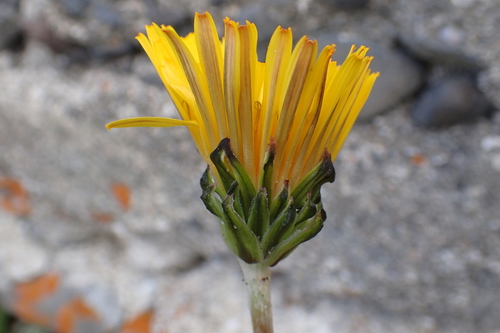
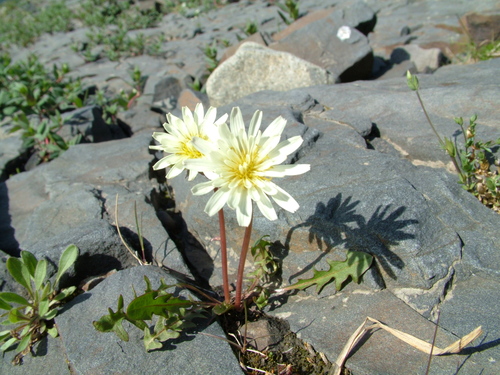
Taraxacum arcticum (Trautv.) Dahlst. is a moderately long-lived perennial herb with a whitish taproot, forming a rosette of five to eight green leaves. It sometimes grows individually, and sometimes forms loose clumps. Its leaves measure 5 to 10 cm (2 to 4 in) long and 1 to 1.5 cm (0.4 to 0.6 in) wide, featuring several deep lobes and a long triangular terminal lobe. Inflorescences emerge directly from the leaf rosette; each inflorescence sits on a long pinkish stem that often curves downward and bears transverse wrinkles. Each flowering stem supports a single flower head made up of multiple bisexual florets; the ligules are white or creamy-white, with a purple streak on their underside. The brownish-black fruits have several shallow ridges, and are topped by white pappi that form parachute structures for seed dispersal. This species occurs mainly in arctic regions of northern Europe and Asia. Its native range extends from northern Greenland and Svalbard to the Chukchi Peninsula in northeastern Siberia. It grows in damp meadows and on heaths, on both level and sloping ground, often in sites that receive early snow protection or are enriched by bird droppings. It tolerates acidic, neutral, and alkaline soils. Most Taraxacum species produce seeds regardless of whether flowers have been pollinated. Within the genus, some species produce ripe-looking yellow pollen, while others have green or blackish-green pollen. Pollen in both groups is thought to be non-functional. Among boreal and arctic Taraxacum species, only Taraxacum holmenianum is suspected to require pollination for reproduction. T. arcticum is counted among the species thought not to rely on pollination, yet it flowers prolifically and produces abundant viable seed that is widely dispersed by wind. Limited local dispersal also occurs via fragmentation of its fleshy roots.