About Taraba major (Vieillot, 1816)
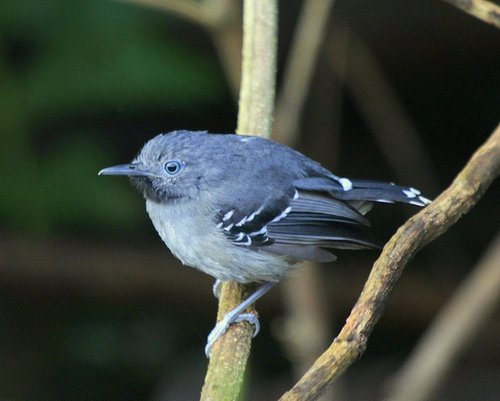
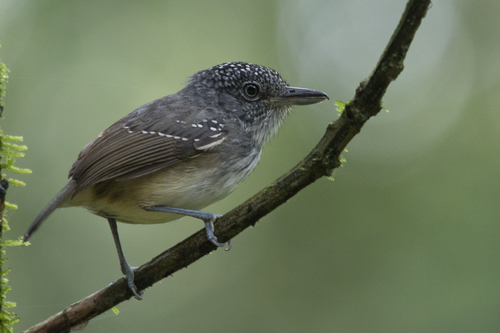
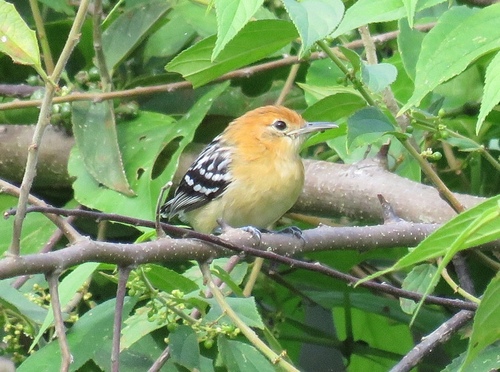
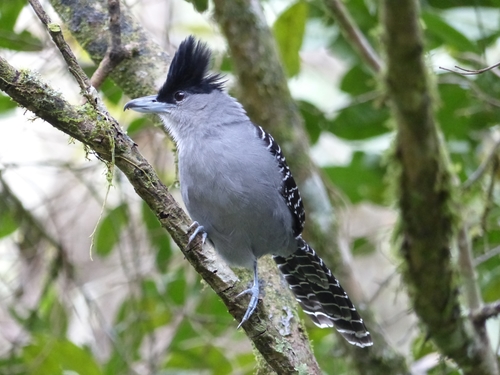
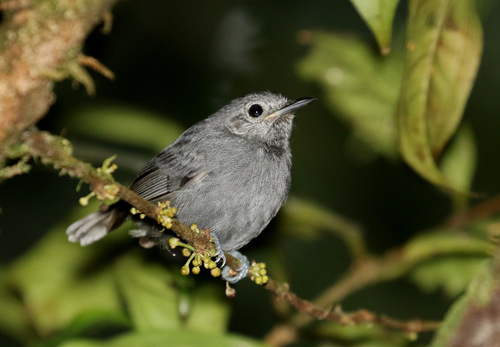
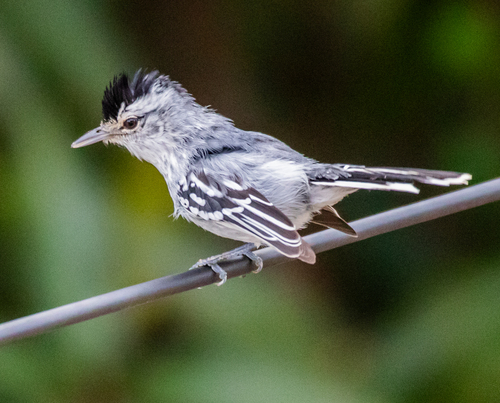
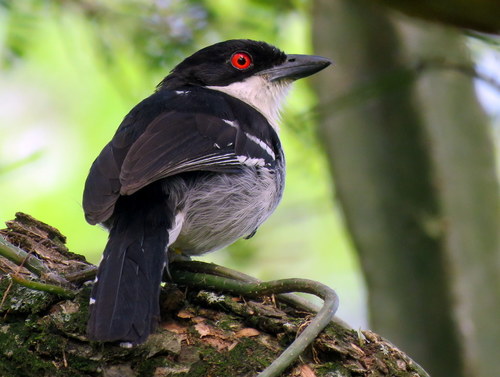
The great antshrike (Taraba major) is a large, distinctive bird, measuring 19 to 20 cm (7.5 to 7.9 in) long and weighing 47.5 to 70 g (1.7 to 2.5 oz). The species shows notable sexual dimorphism, but both sexes of all subspecies share a large crest, red iris, and a heavy black bill hooked at the end like that of true shrikes. Adult males of the nominate subspecies T. m. major have black plumage on the head that extends below the eye. Their upperparts are mostly black, with a usually hidden white patch between the scapulars. Their wings are black with large white spots on the coverts that form bars when perched, and white edges along the primaries. Their tail is black with white spots on the outer feathers, while their chin, throat, and the rest of the underparts are white, with a gray tinge on the flanks. Adult females have a rufous crown and browner lores and ear coverts. Their upperparts and wings are reddish yellow-brown, with paler edges on wing feathers, and their tail is rufous. Their chin, throat, and the center of the breast are white; their crissum is light cinnamon, and the rest of the underparts are white with a cinnamon tinge. Juveniles have cinnamon or buff barring on both their upper- and underparts, which remains faint in subadults. The other recognized subspecies differ from the nominate and each other as follows: T. m. melanocrissus: the black on the male's face extends lower, and the male's crissum is black. T. m. obscurus: males match melanocrissus but have white tips on crissum feathers; females have richer coloration. T. m. transandeanus: males match obscurus but have more white on the crissum; females have even richer coloration. T. m. granadensis: the black on the male's face is similar to the nominate, with much white on the black crissum; females are similar to transandeanus. T. m. stagurus: among all subspecies, males have the most white on the primaries and tail, and the least gray on the underparts; females are the palest of all subspecies. T. m. semifasciatus: males have slightly less white on the primaries and tail than stagurus, and a deeper gray crissum than the nominate. T. m. duidae: males resemble semifasciatus with slightly more white; females are darker than most, with faint blackish streaks and bars on the underparts. T. m. melanurus: males have an entirely black tail, white flanks, and a white crissum. T. m. borbae: males have a moderate amount of white on the wings and tail, and a light gray crissum. Subspecies of the great antshrike are distributed across the following ranges: T. m. melanocrissus ranges from northern Oaxaca and southern Veracruz in Mexico, south along the Caribbean slope through Belize, Guatemala, Honduras, Nicaragua, and Costa Rica into western Panama. T. m. obscurus occurs on the Pacific slope from western Costa Rica, south through Panama into Colombia's Cauca River valley, and along most of Colombia's Pacific slope. T. m. transandeanus ranges from Nariño Department in far southwestern Colombia, south through western Ecuador into the Department of Tumbes in far northwestern Peru. T. m. granadensis is found in northern and central Colombia from Córdoba Department south to Meta Department, and east into northwestern Venezuela as far as Miranda state. T. m. semifasciatus occurs in Trinidad, Vichada Department in far eastern Colombia, northern and central Venezuela, the Guianas, and Brazil east of the Negro River to the Atlantic, south to northern Mato Grosso and northwestern Goiás. T. m. duidae is restricted to Venezuela's Cerro de la Neblina in Amazonas and Cerro Jaua in Bolívar. T. m. melanurus ranges from southeastern Colombia south through eastern Ecuador into eastern Peru, and east into Brazil south of the Amazon to the middle reaches of the Purus River. T. m. borbae is found in Brazil in eastern Amazonas and far northern Rondônia states. T. m. stagurus occurs in eastern and northeastern Brazil, roughly bounded by eastern Maranhão, Pernambuco, eastern Minas Gerais, and Espírito Santo. The nominate subspecies T. m. major is found in northern and eastern Bolivia, Brazil from southern Mato Grosso to western Minas Gerais, Mato Grosso do Sul, and western São Paulo states, and northern Argentina south to northern Buenos Aires Province. The South American Classification Committee of the American Ornithological Society has recorded vagrant individuals in Uruguay. The great antshrike inhabits a wide variety of semi-humid to humid tropical landscapes, and in most areas it favors locations with dense understorey vegetation. On the Pacific slope, its range extends slightly into the subtropical zone. Habitats it uses include gallery forest, savanna woodlands, younger secondary forest, evergreen forest edges and clearings, river islands, and locally drier (but not arid) areas. It is often associated with stands of bamboo. The only exception to these general habitat preferences is subspecies T. m. stagurus, which lives in deciduous forest and the taller sections of caatinga. Across most of its range, the great antshrike occurs below 1,000 m (3,300 ft) in elevation, but it reaches 1,100 m (3,600 ft) in Costa Rica, 1,400 m (4,600 ft) in Colombia, 1,500 m (4,900 ft) in Peru, and 2,200 m (7,200 ft) in Venezuela. In northern Central America, it rarely exceeds 750 m (2,500 ft).