About Tapirus pinchaque (Roulin, 1829)
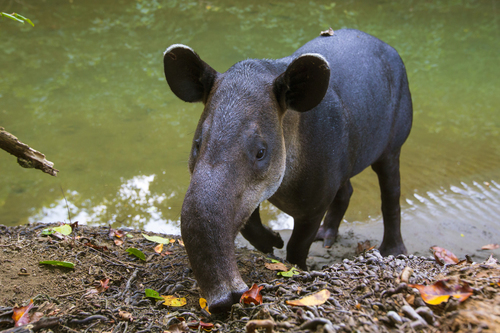
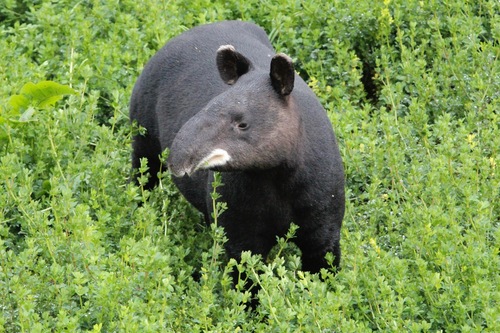
Tapirus pinchaque (Roulin, 1829), commonly called the mountain tapir, has black or very dark brown fur, with occasional pale hairs flecked throughout the darker coat. The fur is noticeably paler on the underside, around the anal region, and on the cheeks. A distinct white band encircles the lips, though this band can vary in how far it extends; white bands also typically run along the upper surface of the ears. Adult mountain tapirs have paired patches of bare skin on the rump, which may help indicate sexual maturity. Their eyes are blue at birth, but shift to pale brown as the animal ages. Unlike all other tapir species, mountain tapir fur is long and woolly, especially on the underside and flanks, and can reach 3.5 cm (1.4 in) or longer in some individuals. Full-grown adults are usually around 1.8 m (5 ft 11 in) long, and stand 0.75 to 1 m (2 ft 6 in to 3 ft 3 in) tall at the shoulder. They typically weigh between 136 and 250 kg (300 and 551 lb). While the sexes are similar in overall size, females tend to be 25 to 100 kg (55 to 220 lb) heavier than males. Like other tapirs, they have small, stubby tails and long, flexible proboscises. They have four toes on each front foot and three toes on each back foot; each toe has a large nail, and the foot is supported by a padded sole. A pale pink or grey patch of bare skin extends just above each toe. No subspecies of the mountain tapir are currently recognised. The mountain tapir lives in cloud forests and páramo on the Eastern and Central Cordilleras mountains in Colombia, Ecuador, and the far north of Peru. Its range may once have extended as far as western Venezuela, but the species has been extirpated from that area for a long time. It most commonly occurs at elevations between 2,000 and 4,300 metres (6,600 and 14,100 ft). Since temperatures at this elevation routinely drop below freezing, the mountain tapir’s thick woolly coat is essential for survival. In the wet season, mountain tapirs tend to stay in Andean forests; during drier months, they move into páramo habitats, where they face fewer biting insects. In Peru, the species is protected within the National Sanctuary Tabaconas Namballe. To breed successfully and maintain healthy populations, mountain tapirs require continuous stretches of cloud forest and páramo rather than isolated habitat patches. This requirement is a major concern for conservationists working to protect this endangered animal. Female mountain tapirs have a 30-day estrous cycle, and typically only breed once every other year. During courtship, the male chases the female and uses soft bites, grunts, and squeals to get her attention, while the female responds with frequent squealing. After a gestation period of 392 or 393 days, the female gives birth to a single young; multiple births are very rare. Newborn mountain tapirs weigh between 5.4 and 6.2 kg (12 to 14 lb), and have a brown coat marked with yellowish-white spots and stripes. Like adults, infant mountain tapirs have thick, woolly fur to help retain body heat. Weaning begins around three months of age. The young’s distinctive immature coat color and patterning fades after about one year, but the mother continues caring for her young until it is around 18 months old. Mountain tapirs reach sexual maturity at three years of age, and have been recorded living up to 27 years in captivity. Mountain tapirs are herbivores that eat a wide range of plants, including leaves, grasses, and bromeliads. In the wild, their particularly common foods include lupins, Gynoxys, ferns, and umbrella plants. They also actively seek out natural salt licks to meet their requirement for essential minerals. Mountain tapirs are important seed dispersers in their native ecosystems, and are identified as a keystone species of the high Andes. A relatively high proportion of plant seeds eaten by mountain tapirs successfully germinate after being passed in the animals’ dung. This is likely due to the species’ relatively inefficient digestive system and a tendency to defecate near water. While a wide variety of seeds are dispersed this way, seeds of the endangered wax palm appear to rely almost exclusively on mountain tapirs for dispersal. Both the endangered wax palm and highland lupine decline dramatically whenever mountain tapirs are removed from an area. Known predators of mountain tapirs include cougars and spectacled bears; jaguars also hunt them less commonly. Attacks on mountain tapirs by invasive domestic dogs have also been reported.