About Tapirella bairdii (Gill, 1865)
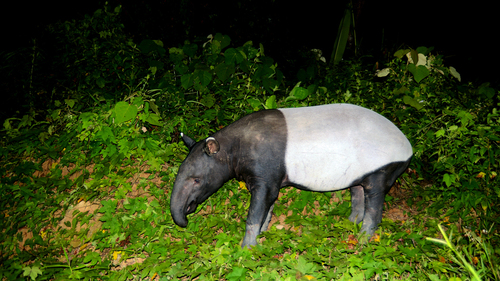
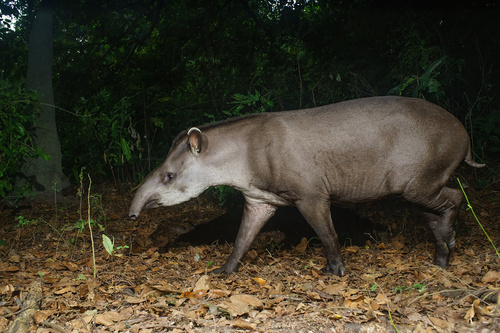
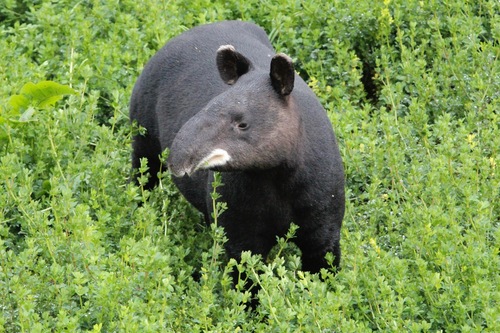
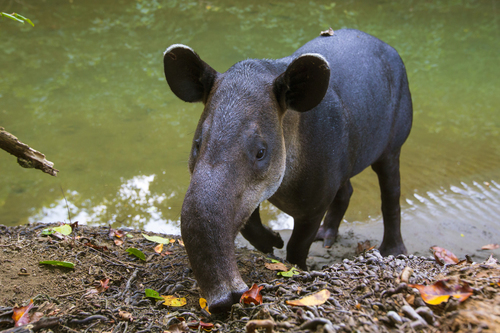
Baird's tapir (scientific name Tapirella bairdii (Gill, 1865)) has distinctive cream-colored markings on its face, throat, and the tips of its ears, with a dark spot on each cheek, behind and below the eye. The rest of its bristly hair is dark brown or grayish brown. This species is very muscular, and is roughly the size of a small donkey. A long thin mane is present, but it is not always conspicuous. It has two small oval-shaped eyes that sit flush against the sides of the head. Its ears are large, oval-shaped, and not very mobile. Baird's tapirs average 2 m (6 ft 7 in) in total length, ranging from 1.8 to 2.5 m (5 ft 11 in to 8 ft 2 in) not counting a stubby, vestigial tail that measures 5–13 cm (2.0–5.1 in) long. Shoulder height ranges from 73–120 cm (29–47 in). Adult body mass can range from 150 to 300 kg (330 to 660 lb). Like all other tapir species, Baird's tapirs have small, stubby tails. Their snout and upper lip project forward to form a fleshy, flexible proboscis. This proboscis is the species' strongest sensory organ, and it aids in finding food and detecting physical stimuli. Their legs are short and slender, and are well adapted for rapid movement through dense underbrush. They have four toes on each front foot, and three toes on each back foot. Baird's tapir occupies many diverse types of vegetation, and can tolerate elevations from sea level up to 3,600 m (11,800 ft). It can be found in wet habitats including mangrove forests, marshes, swamps, and wet tropical rainforests. It also lives in drier habitats such as riparian woodlands, deciduous forests, and mountainous cloud forests. When available, Baird's tapir prefers secondary growth forests, because these habitats have more understory plants for foraging and protection. Food and water availability, along with protection, are key factors that influence this species' habitat selection.