About Taphozous mauritianus E.Geoffroy, 1818
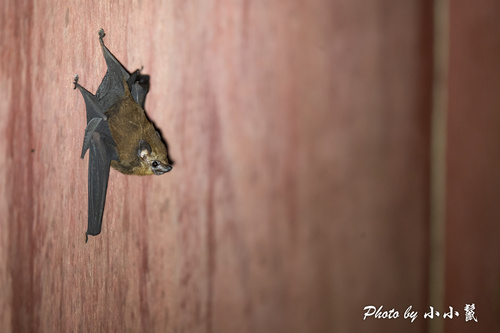
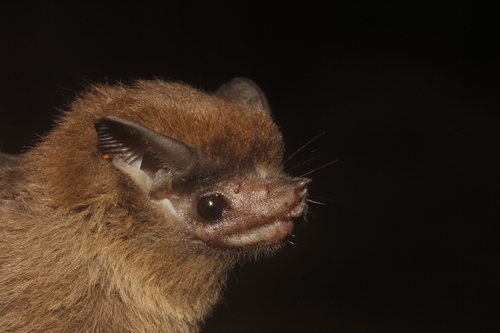
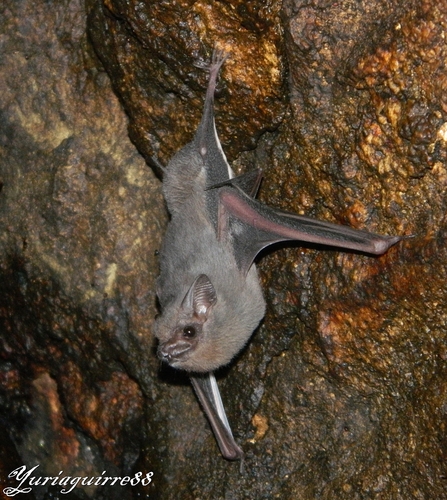
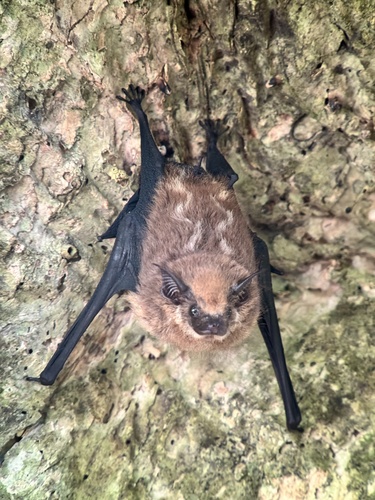
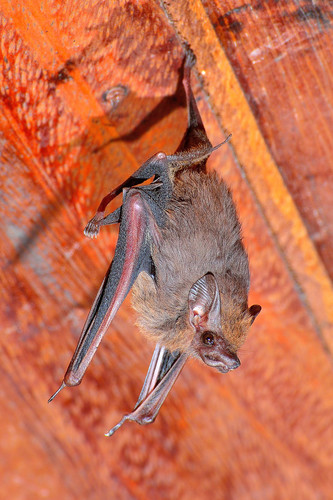
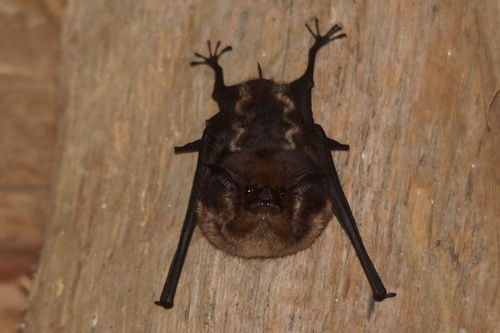
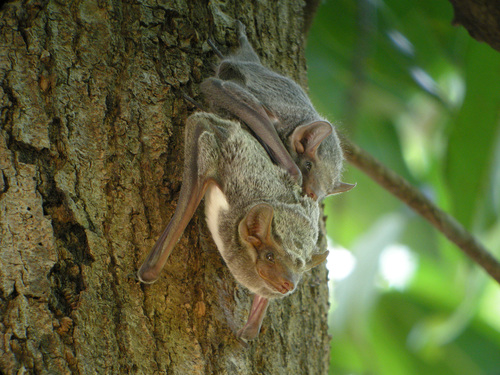
The Mauritian tomb bat, scientifically named Taphozous mauritianus E.Geoffroy, 1818, can be distinguished from other bat species by its completely white ventral area. The dorsal surface of this bat is mottled with multiple shades of brown, gray, and white, creating a grizzled "salt and pepper" appearance. It has short, sleek fur, and its primarily translucent beige wing membranes are attached to long, narrow wings. When not in flight, the wings shorten to make crawling easier — a trait unique to this genus. Males and females are similar in both color and size. Generally, adults are lighter in color than juveniles, which have a more prominent gray hue. This species has a cone-shaped face covered with a thin layer of hair, the area below and in front of the eyes is hairless, and the front of the face is sunken around the large (2–3 mm) eyes. Its ears are triangular, erect, and have rounded edges, and the inner margins of the ears do not have papillae, the inner sensory surface of a bat's ear. As one of the larger species in the Microchiroptera suborder, fully grown adult Mauritian tomb bats weigh 25 to 36 grams (0.88 to 1.27 oz), with forearms measuring 58 to 64 millimetres (2.3 to 2.5 in) and total body lengths of 10 to 11 centimetres (3.9 to 4.3 in). The Mauritian tomb bat has a wide distribution across central to southern Africa, and on many of the surrounding islands. It has been recorded in Angola, Benin, Botswana, Central African Republic, Chad, Republic of the Congo, Democratic Republic of the Congo, Ivory Coast, Equatorial Guinea, Ethiopia, Gabon, Gambia, Ghana, Kenya, Madagascar, Malawi, Mauritius, Mozambique, Namibia, Nigeria, Réunion, São Tomé and Príncipe, Senegal, Seychelles, Sierra Leone, Somalia, South Africa, Sudan, Swaziland, Tanzania, Togo, Uganda, Zambia, and Zimbabwe. Special kidney adaptations help the Mauritian tomb bat conserve water, allowing it to survive in the frequently dry, semi-arid regions of countries like Sudan and Chad. This bat has a mean renal index of 5.55: its inner kidney medulla (the section that collects waste) is very large relative to the overall organ size, letting it remove most waste from the water it consumes. The species has a predicted mean maximum urine concentration of 3,921 mosmol/kg, meaning it produces very concentrated urine. From these traits, scientists have tentatively concluded that the species' kidneys support effective water conservation. Mauritian tomb bats occur occasionally in grassland biomes, as well as semi-arid and tropical regions, including forests, rainforests, grasslands, and parts of the Sahara that receive less than 500 mm of rainfall per year. They prefer open, moist savanna with plenty of room to maneuver and roosting sites close by, and are often found near open swamps and rivers that provide a steady food supply; open water may also be necessary for hunting. This species avoids dense sections of tropical forest because it has limited turning maneuverability. In countries such as São Tomé and Príncipe, groups of Mauritian tomb bats roost in cocoa trees on large plantations, which provide a good environment with suitable roosts, adequately spaced trees, and abundant insect prey. Mauritian tomb bats prefer roosting sites that have overhead shelter but are in exposed positions to make takeoff easier. Natural roosting locations include palm tree trunks, caves, and crevices. Since human settlement, they have adapted to roost in new locations including building sides and, as their common name suggests, tombs. They prefer buildings with bare brick surfaces over painted ones, as bare brick provides better grip. They select day roosts such that no obstacles block takeoff. Mauritian tomb bats are most often found in groups of around five individuals. These groups are usually entirely male or entirely female; in mixed-gender groups, males and females are separated by at least 10 centimetres (3.9 in). Females live together in groups of 3 to 30, while males live alone except during the mating season. Unlike some bat species, they do not roost tightly packed together, and instead space out loosely — the only exception is a mother and her offspring. In some locations, including Shai Hills Resource Reserve in Ghana, groups of at least 100 bats have been observed. They typically roost with their ventral side pressed flat against a surface. The Mauritian tomb bat is nocturnal and rests during the day, but does not sleep much and remains alert while roosting. If disturbed, it will fly to a new site or move quickly under building eaves. It very rarely travels far from its day roosting site, and roosts are often recolonized over time. Over time, roosts become stained brown with gular sack secretions and urine; these stains are typically rectangular, around 150 mm long and 100 mm wide. The species' semi-diurnal activity has led to the evolution of relatively good eyesight, unlike most echolocating bats. Its vision is very similar to the vision of Old-World bats, and the presence of the dim-light (RH1) gene in both Mauritian tomb bats and Old-World bats suggests convergent evolution of this gene in similar light-rich environments. Mauritian tomb bats can detect movement from far away, indicating their eyesight is superior to that of other insect-eating bats. This advanced eyesight plays a large role in selecting suitable day roosts and detecting predators. The Mauritian tomb bat is mostly a nocturnal hunter, though it occasionally forages during the day. It prefers to hunt in open spaces like open fields or bodies of water, so it can easily swoop down to catch insect prey. It captures and consumes prey while still in flight. Its preferred food is moths, though during daylight it preys on butterflies and termites. In the regions it inhabits, it often helps control pest populations, which is important because these areas are frequently affected by insect-borne diseases such as malaria. It usually waits until full darkness before starting to forage. It can detect prey at long ranges over open areas, makes periodic dives while hunting, and increases its echolocation rate with each dive. Mauritian tomb bats are polygamous. Depending on the region, they mate once or twice per year. Populations in the Southern African subregion often produce two pups annually: one born in February or March, and another born between October and December. In other populations, mating occurs in December, followed by a four to five month gestation period, and birth takes place in April or May. Mothers give birth to one pup per litter. Only mothers care for young after birth, and males do not participate in raising offspring. The pup clings to its mother's abdomen when she flies and when she is perched. It stays with the mother, clinging to her chest wherever she goes, until it is able to fly. The mother nurses the pup during this time, and the pup drinks her milk until it is weaned onto the adult insect diet. The time spent with the mother lets young bats observe hunting behavior and learn other skills they need to survive as adults. Once a young bat can fly, it can forage on its own, and may either stay in its mother's colony or join a different colony once fully grown.