About Tapera naevia (Linnaeus, 1766)
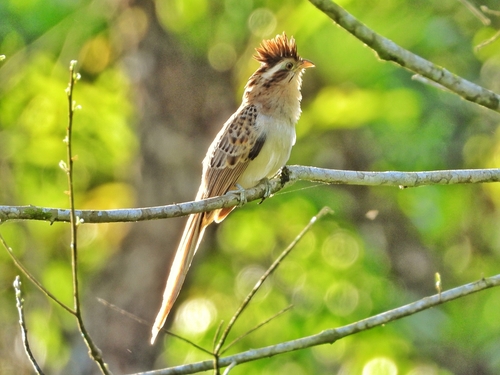
The striped cuckoo, with the scientific name Tapera naevia, is a near-passerine bird and the only species that belongs to the genus Tapera. This non-migratory resident cuckoo occurs from Mexico and Trinidad, south through Colombia to Bolivia and Argentina. It inhabits open landscapes with scattered trees or shrubs, as well as mangrove forest edges. It is one of only a small number of brood parasitic cuckoo species found in the Americas; the only other brood parasitic cuckoos in the region are members of the genus Dromococcyx. Its most typical hosts are spinetails, but it also frequently uses wrens and other bird species that build domed nests as hosts. The female striped cuckoo lays one, and sometimes two, white or bluish eggs into the large stick nest of its chosen host. The cuckoo eggs hatch after 15 days of incubation, and the young cuckoo fledges 18 days after hatching. The host spinetail chicks do not survive after the cuckoo chick hatches. This species reaches approximately 27 cm (11 in) in length and weighs 40 g (1.4 oz). Adult striped cuckoos are primarily grey-brown on their upperparts, streaked with black and buff. They have a pale supercilium, a chestnut and black crest that is raised during display, off-white underparts, and a long, graduated tail. Immature birds have buff spotting, and are more rufous in color on their back and wings. The striped cuckoo feeds on large insects, primarily grasshoppers and caterpillars, which it often catches from the ground. This species is solitary and fairly shy, and tends to stay hidden within bushy cover, though it will sing from more open perches. Its call is a whistle that usually consists of two or three notes, sounding like wu-weee or wu-wu-wee, and the birds can be drawn out by imitating this call.