About Tapeigaster nigricornis (Macquart, 1851)
Scientific name: Tapeigaster nigricornis (Macquart, 1851)
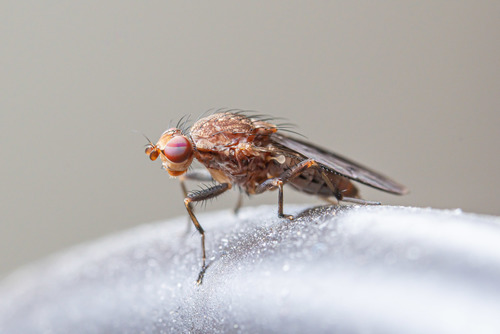
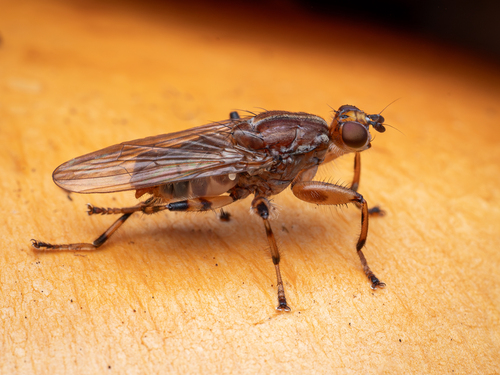
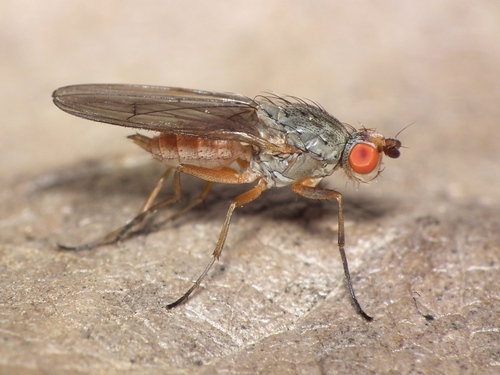
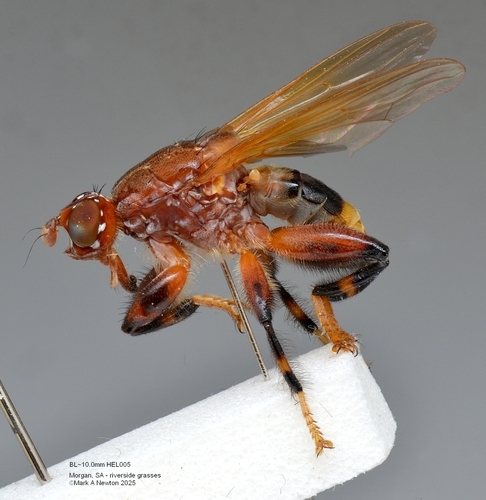
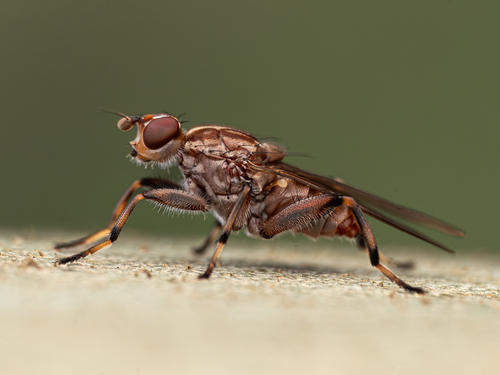
Adult T. nigricornis are medium-sized flies. Their bodies measure 6 mm (0.24 in) long, and their wings measure between 5–7 mm (0.20–0.28 in) long. The antennae are black, slightly shorter than the face, and have a long, bare arista. All bristles on the head and thorax are black. The frons is yellow at the front of the head and red toward the back, with two bright white stripes that border the eyes. The thorax is reddish-brown, with a grey longitudinal stripe running down the middle of the mesoscutum from the neck to the scutellum, and a grey band running from near the neck to the base of the wing on each side. The halteres are white with a reddish stalk, and the scutellum is reddish-brown with a light dusting of grey. The femora are reddish but covered with grey pruinescence (a grey dust coating) that sometimes appears shiny. The fore and hind femora are moderately swollen, while the mid femora are not swollen and are visibly thinner. All femora have black bristles on their upper surface and a covering of white hairs on their lower surface. The tibiae are yellowish; the fore and mid tibiae darken toward the tarsi, while the hind tibiae are darkened at both ends. The tarsi are yellowish closest to the tibia and become black toward the claws. The wings are transparent with reddish veins. The abdomen is reddish and pubescent, with short dark hairs on its upper surface and longer white hairs on its sides. The second to fifth abdominal segments are bordered with grey. The male genitalia is red with scattered white hairs, and the female ovipositor is also red. This species is associated with several species of fungus, including Amanita ochrophylla and Omphalotus nidiformis.