About Tanysiptera sylvia Gould, 1850
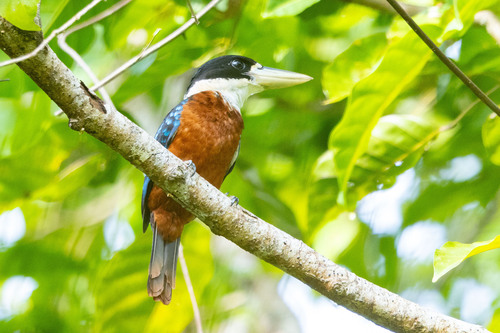
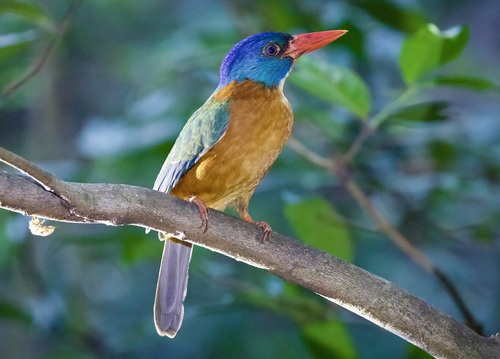
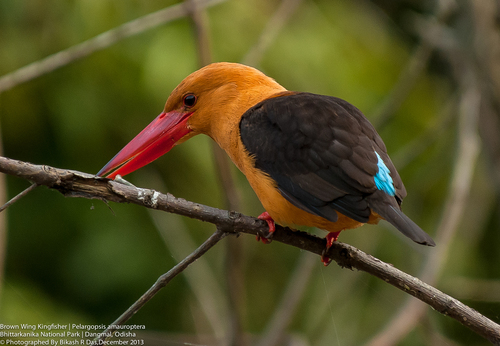
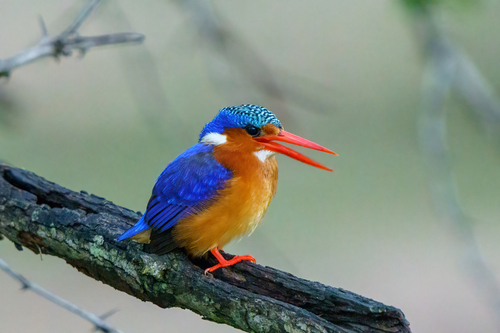
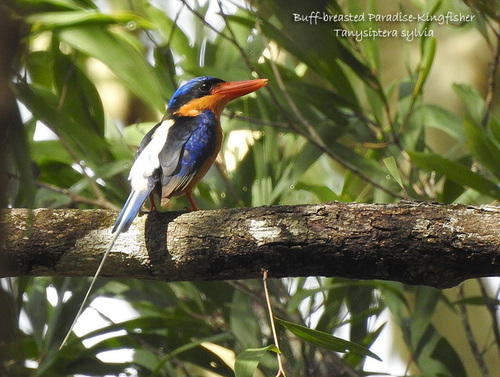
Like all paradise kingfishers, the buff-breasted Tanysiptera sylvia is brightly coloured. It has a large red bill, rich rufous-buff underparts, blue or purple cap, crown and outer tail feathers, black eye stripes that run down to the nape, red feet, a white lower back and rump, and long white or blue-and-white tail feathers that vary in appearance geographically. Its key identifying feature is the white patch on the centre of the upper back. Juveniles have a brown bill and yellowish feet, are duller in colour, and do not have long tail feathers. An adult male measures 35 cm (14 in) in total length; this includes tail feathers that extend 13 cm (5.1 in) beyond the rest of the tail. An adult female measures 30 cm (12 in) in total length, with much shorter tail feathers that extend 8 cm (3.1 in) beyond the rest of the tail. Overall tail length varies between individuals, and averages approximately 18 cm (7.1 in). Tail feathers of juveniles and immature individuals are shorter than those of adults. Tail feathers are often damaged toward the end of the breeding season, most likely from entering and leaving the nesting burrow, and regrow before the next mating season. The wingspan of an adult male is 35 cm (14 in), while the wingspan of an adult female is 34 cm (13 in). Adult buff-breasted paradise kingfishers weigh 45–50 g (1.6–1.8 oz). During the November to March breeding season, this species is found in coastal north-east Queensland, from the Torres Strait islands and Cape York Peninsula south to Byfield in central Queensland. Individual sightings have also been recorded at Eurimbula National Park (south of Gladstone) and on islands of the Great Barrier Reef. The buff-breasted paradise kingfisher lives in lowland monsoon rainforest, and in isolated patches of hill forest, in areas that have active termite mounds suitable for nesting. It typically perches in the mid-storey and lower canopy of these forests, and comes down to the ground to feed.