About Tanysiptera galatea G.R.Gray, 1859
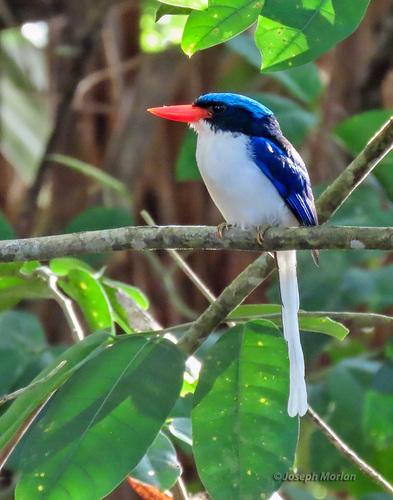
This species, the common paradise kingfisher (Tanysiptera galatea G.R.Gray, 1859), is a kingfisher with a red bill, a dark turquoise cap that has brighter blue edges, blackish cheeks, and bluish-black upper parts. Its underparts are white, and its under-wing coverts are blue and white. The central tail feathers are elongated, with blue bases. It looks very similar to the buff-breasted paradise kingfisher (Tanysiptera sylvia), differing only in breast color, and the two species coexist in some parts of Papua New Guinea.
The common paradise kingfisher inhabits the forested interior of New Guinea and some offshore islands to the north of New Guinea. Its distribution is fairly patchy: on the New Guinea mainland, it mostly occurs at elevations below 500 m (1,600 ft), and on Karkar Island it occurs up to 820 m (2,700 ft). On certain nearby islands, it is replaced by closely related sister species: the Biak paradise kingfisher (T. riedelii) on Biak Island, the Kofiau paradise kingfisher (T. ellioti) on Kofiau Island, and the Numfor paradise kingfisher (T. carolinae) on Numfor Island. It appears that each of these island species originated from founding populations of T. galatea that became isolated from mainland populations and underwent a genetic revolution. No specific biotic factors were involved in this process; sufficient genetic variation existed among the founding birds to allow speciation, and the set of genes carried by the population on each island was never later altered by incoming genes from outside populations.
The common paradise kingfisher is a common, mostly non-migratory species, although some individuals move out of monsoon rainforest during the dry season. A mated pair defends a territory of 0.3 to 0.5 hectares (0.7 to 1.2 acres). This kingfisher builds its nest inside an active termite nest located on a tree. Termites build their termitarium against the tree trunk, and the birds excavate a tunnel up to 15 cm (6 in) long that ends in a 13 cm (5 in) nesting chamber. The birds typically test multiple sites before settling on one to use. Females lay a clutch of around five eggs between November and March, and both parent birds care for the young.
The diet of the common paradise kingfisher is made up of invertebrates including earthworms, grasshoppers, beetles, caterpillars, centipedes, and snails, and occasionally includes lizards. The bird perches upright on a low branch, staying still for long periods, only occasionally twisting its head or flicking its tail. When it spots movement below, it swoops down to the forest floor to pounce on prey, then returns to the branch with its catch. The bird may dismember its victim or subdue it by bashing it against the branch. It plucks some insects directly from foliage, and seeks earthworms by foraging through leaf litter and probing leafmould with its beak.