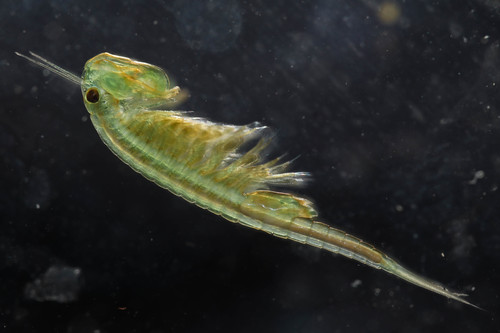
About Tanymastix stagnalis (Linnaeus, 1758)
Tanymastix stagnalis (Linnaeus, 1758) has a pair of stalked eyes and 11 pairs of flattened thoracic appendages called phyllopodia. Its abdomen bears no appendages except for the caudal furca and external genitalia. Males have a pair of retractable hemipenes as genitalia, while females have a brood pouch with two spines. The antennae are sexually dimorphic, and are prehensile in males. At the tip of the abdomen, the caudal furca is formed of two long, thin, setose red cercopods. Reported body lengths for Tanymastix stagnalis vary by location: Spanish specimens reach 7–9 mm (0.3–0.4 in), Macedonian specimens reach 8–17 mm (0.3–0.7 in), and French specimens have been recorded at up to 20 mm (0.8 in). This species can be most easily distinguished from other members of its order by the shape of the male antennae and frontal appendages. Tanymastix stagnalis has a scattered, wide circum-Mediterranean distribution across Europe and Algeria, stretching from the Iberian Peninsula in the west to south-western Russia in the east, and extending north through Germany to Scandinavia. Specific scattered populations are recorded: in North Macedonia, it occurs only in pools among andesite tuffs above Stracin, while in Denmark it is only known from Råbjerg Mile pools. It was first described from a site near Uppsala, Sweden, which lies near the northern edge of its range. A more northerly population was discovered in 1913 at 1,100 m (3,500 ft) altitude above Surendal, Norway; this population is likely extinct, but the species is still found at three other high-altitude sites in the Trollheimen mountains. Tanymastix stagnalis is the only anostracan species found in Ireland, and one of only two present in the British Isles; the other is Chirocephalus diaphanus, which occurs at a small number of sites in southern England. Tanymastix stagnalis was first discovered in Ireland at Rahasane Turlough in 1974, and was soon found at six other sites in temporary field pools, a habitat that may reflect the species' typical environment. It is thought to have reached Ireland via mud carried on the legs of migratory birds, or on the footwear of a wildfowler; multiple migratory duck species (mallard, teal, shoveller) and wader species (lapwing, curlew) are observed in Ireland after migrating from Tanymastix stagnalis ranges such as Scandinavia and France. In France, the species is found in the Forest of Fontainebleau near Paris, the Camargue, the Var, the Rhône Valley, and on the islands of Corsica, Sardinia and Capraia. Tanymastix stagnalis survives periods of drought as resting eggs. These eggs are dark coppery-brown, 0.40–0.43 mm in diameter, and characteristically lentil-shaped for the genus Tanymastix. Each ovisac produces 8–14 eggs, which are laid in open water. The eggs usually float, and tend to accumulate along pool edges. Eggs hatch into nauplii, but this larval stage only lasts a few hours. Individuals reach sexual maturity 7–40 days after hatching, and lifespan depends on temperature and season, ranging from 30 days in summer to over 60 days in winter. Like other anostracans, T. stagnalis swims with its ventral side facing upwards, using beating movements of its flattened phyllopodia. It has been described both as a cold stenothermal species and a warm stenothermal species; its temperature tolerance varies between populations. Some populations have an upper temperature limit of 16 °C (61 °F), Irish populations have a maximum limit of 20 °C (68 °F), and populations in Germany and other locations tolerate up to 25 °C (77 °F). Reported optimum temperatures are either 10–17 °C (50–63 °F) or 12–15 °C (54–59 °F), and nauplii have been observed at 3–12 °C (37–54 °F). In North Macedonia, T. stagnalis lives in small pools 20–60 cm (7.9–23.6 in) in diameter and 10–20 cm (3.9–7.9 in) deep, holding just a few litres of water each; larger local pools host Chirocephalus diaphanus instead. In Spain, the species has a seasonal distribution: it occurs in rain puddles on plains in winter, and is only found in mountainous areas in summer. Across its range, the pools it inhabits overlie acidic igneous rocks, are typically low in minerals, and retain some moisture in their sediment when they dry out. Like all anostracans, Tanymastix stagnalis is a filter feeder that strains microplankton, microorganisms and other organic material from suspension using its bristly phyllopodia. The species is sensitive to changes in light intensity, and responds to sudden shade by swimming towards the bottom of the pool, or even burying into the sediment. The main threat to Tanymastix stagnalis is habitat disturbance, particularly the introduction of predatory fish such as Lepomis gibbosus and Gambusia affinis.

