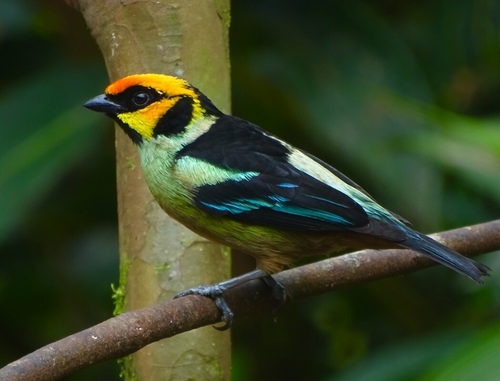
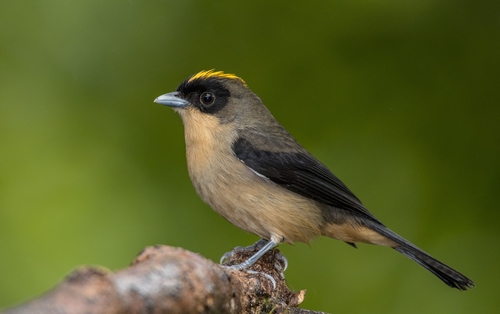
About Tangara vassorii (Boissonneau, 1840)
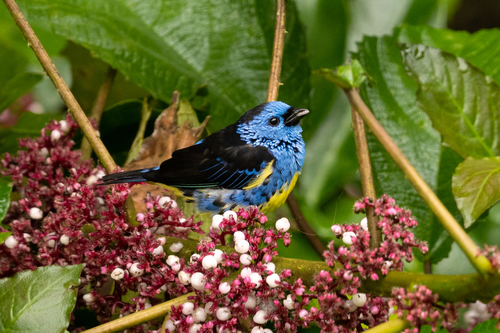
The blue-and-black tanager (scientific name Tangara vassorii) is an average-sized species within its genus, with an average length of 13 cm (5.1 in) and average mass of 18 g (0.63 oz). This species shows slight sexual dimorphism: females are slightly duller in coloration than males. Adult males are primarily cobalt blue with a black mask. Their wing and tail feathers are black with blue edges. Subadults are mostly gray, but have black wings, tails, and lores. Compared to other species in the genus Tangara, this tanager has a very short bill. The iris is brown, the bill is black, and the feet are wine gray. The blue-and-black tanager can be easily confused with the masked flowerpiercer, but it can be distinguished by its brown eye, more extensive black coloring on the wing, and a shorter, thicker bill. Populations of the subspecies atrocoerulea may also be confused with the golden-naped tanager, but can be told apart by their blacker back and the absence of cinnamon-colored underparts. The blue-and-black tanager is distributed across Bolivia, Colombia, Ecuador, Peru, and Venezuela, in the northern and central Andes. It occurs at elevations between 1,500 m and 3,500 m (4,900 ft and 11,500 ft). It inhabits higher altitudes than any other Tangara species, and it is the only member of the genus found near the tree line. It mostly lives in montane evergreen forest, dwarf forest, and secondary forest. It also occurs in forest edges, vegetation within clearings, and patches of growth near the tree line. It generally remains in the forest canopy. When foraging, the blue-and-black tanager joins large mixed-species flocks, and most often moves in pairs or groups of 3 to 6 individuals. Mixed-species flocks can contain up to 15 blue-and-black tanagers. In Colombia, this species has been reported to be a nuclear species, meaning it helps form and maintain mixed-species flocks. It is found more often alongside Iridosornis or Anisognathus species than it is with other Tangara species.