About Tangara parzudakii (Lafresnaye, 1843)
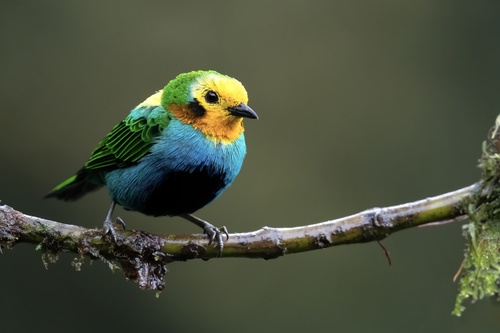
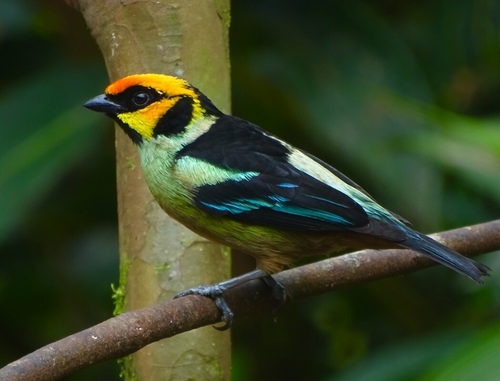
The flame-faced tanager, Tangara parzudakii, is a distinctive medium-sized tanager species. On average, it measures 14–15 cm (5.5–5.9 in) in length and weighs 28 g (0.99 oz). Adult males and females of this species have similar appearance. Most of its body is colored black and silvery green. The auricle, malar region, and forecrown are deep red, while the crown and nape are yellow. The underparts are mostly opalescent green mixed with buff. The central belly is pale cinnamon buff, and the flanks and undertail coverts are darker. The lower back and rump are opalescent golden, and often carry a bluish tinge. The iris is dark brown, the bill is black, and the feet are dark gray. Immature flame-faced tanagers have dull yellow on the head instead of the deep red seen in adults. Their throat is pale buffy gray, and the areas that are black in adult birds are dull dusky. Overall, the plumage of immatures is duller than that of adults. The nominate subspecies is not easily confused with any other tanager species due to its deep red facial plumage. However, the subspecies lunigera resembles the saffron-crowned tanager. It can be distinguished from the saffron-crowned tanager by the latter's greenish breast, yellow crissum (the area surrounding the cloaca), and smaller size. Flame-faced tanagers are native to the Andes of Colombia, Ecuador, Venezuela, and Peru, where they occur at elevations between 1,000 and 2,600 m (3,300–8,500 ft). They inhabit montane forests and cloud forests, and are most common at elevations above 1,500 m (4,900 ft). They can also be found in forest edges and tall secondary growth. Flame-faced tanagers are most commonly observed alone in pairs, or in groups of 3 to 7 birds. They also frequently join mixed-species flocks that are mostly made up of other tanager species. On average, mixed-species flocks that include flame-faced tanagers contain seven other bird species.