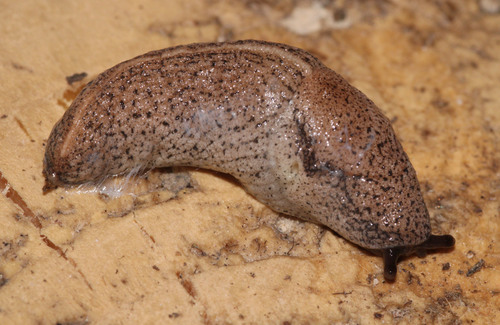
About Tandonia rustica (Millet, 1843)
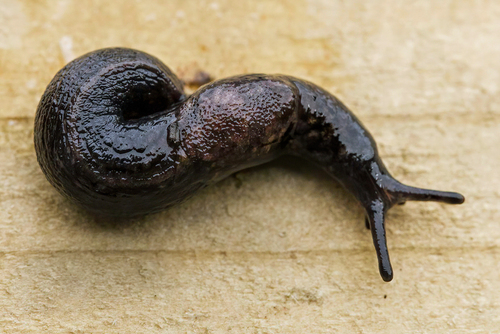
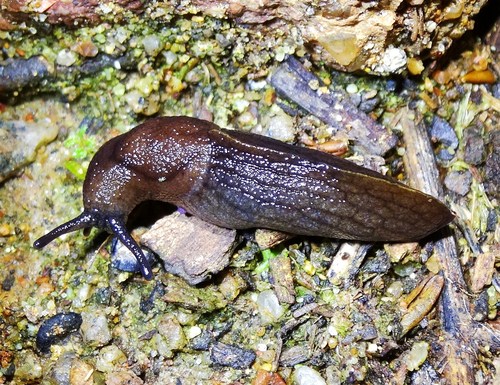
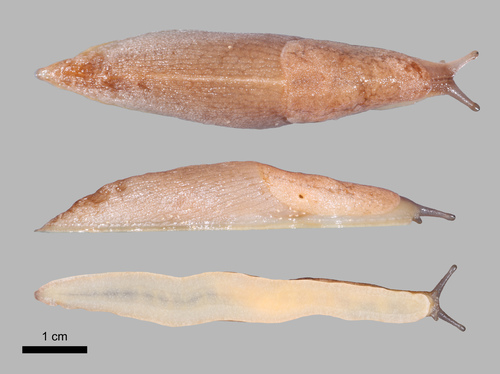
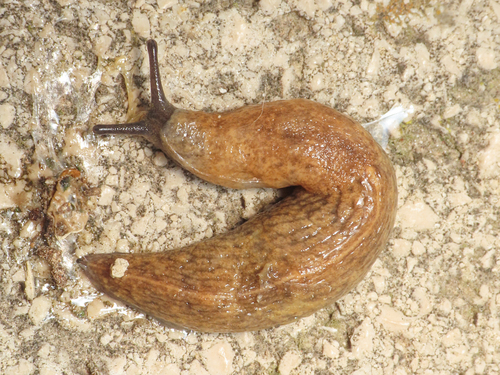
Tandonia rustica is a keeled slug that grows to between 70 mm and 100 mm in length. Its body color ranges from whitish, creamy, or reddish to yellowish grey, and is covered in numerous black dots. In preserved specimens, the mantle measures 40% of the total body length. The mantle has a granular texture, with a deep but not obvious horseshoe-shaped groove marked by black streaks. The breathing pore has a pale rim. The keel is yellowish to white, and the sole of the foot is cream-colored. Internally, the penis and epiphallus form a single long cylindrical structure: the penis has an anterior swelling and contains a richly ornamented papilla, while the epiphallus is noticeably longer than the penis. The vas deferens opens symmetrically. The spermatheca is elongated with a sharp pointed end, and its duct is slightly shorter with a swelling at its midpoint. The vagina is not much wider than the oviduct. Compact, duct-like accessory glands surround the anterior end of the vagina and open into it. The atrium is short. This slug is native to Central Europe, including Austria, Czech Republic, France, Germany, Italy, Liechtenstein, Luxembourg, Poland, Romania, Slovenia, and Switzerland. It has been introduced to a much wider range, including Belgium, Croatia, Corsica, Great Britain, Hungary, Ireland, Slovakia, and the Netherlands. The species has not yet become established in the USA, but it is considered a potentially serious threat as a pest and invasive species that could negatively affect agriculture, natural ecosystems, human health, or commerce. For this reason, it has been suggested that Tandonia rustica be given top national quarantine significance in the USA. Its habitat includes deciduous and mixed forests on mountain slopes with limestone rock rubble, and it also occurs in open habitats on calcareous soils.