About Tandonia budapestensis (Hazay, 1880)
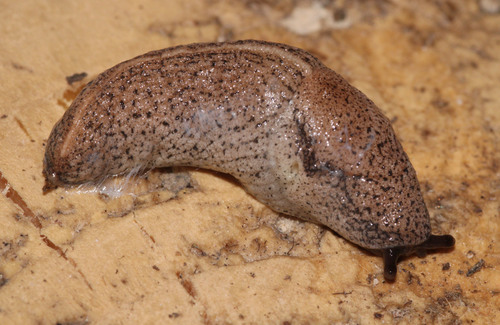
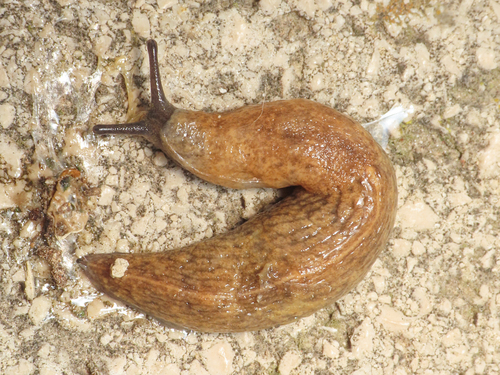
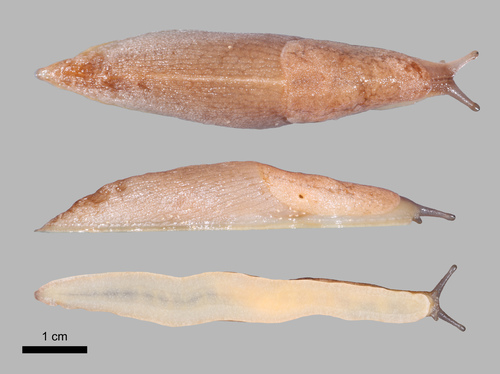
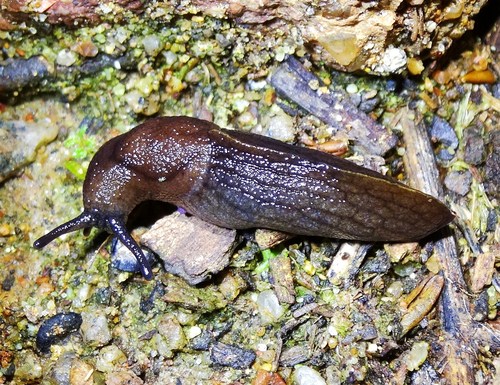
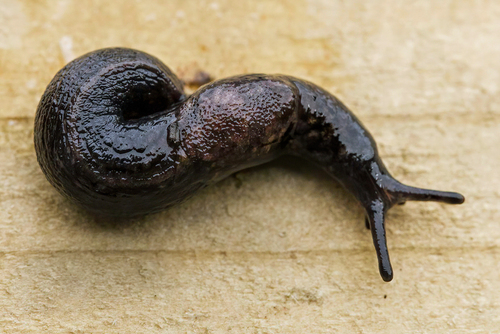
Tandonia budapestensis (Hazay, 1880) is a species of slug. This slug is generally dark brownish grey, with a brighter-colored keel. Its body ranges from yellowish-grey to brown or dark grey, and is covered in numerous black spots, which can make the slug appear evenly black-brown, with a slightly lighter color along the sides. The body is very slender, and gradually narrows toward the posterior end. The mantle is less than one-third of the total body length, with blurry black bands along its sides. The keel is prominent, light-colored, and extends all the way to the mantle. The head and neck are blackish. The narrow sole is cream-colored with a brown or orange tint. Body mucus is usually colorless, thick and sticky, but turns yellowish when the slug is irritated. Live individuals reach a maximum length of 70 mm, while preserved specimens measure 30 to 40 mm long. In its reproductive system, the penis is rounded, wider than and approximately as long as the epiphallus. The vas deferens opening is distinctly asymmetrically placed at the posterior end of the epiphallus. A small simple papilla is present inside the penis. The spermatheca duct is usually thick; the vagina and atrium are short, and two lobe-like accessory glands connect to the vagina via thin ducts. The spermatophore is thin, 16 mm long, and almost entirely covered in short spines. This slug is native to Europe, most likely originating from the southeastern Alps and northern Balkans extending to Hungary and Romania (Transylvania). It has been recorded in many locations including Austria, Bulgaria, the Czech Republic, France, the Hebrides, Hungary, Iceland, Kaliningrad, the Netherlands, Poland, Romania, Slovakia, Turkey, Ukraine, introduced Great Britain and Ireland (the British Isles), as well as introduced New Zealand and the USA. The species is already established in the USA, where it is considered a potentially serious threat as an invasive pest that could negatively impact agriculture, natural ecosystems, human health or commerce. For this reason, it has been suggested that the species should be given top national quarantine significance in the United States. This slug lives mainly in secondary, anthropogenous (man-made) habitats such as farmland, and also occurs in parks, gardens, ruins, and cultivated fields. It is a synanthrope, living in close association with humans. In Britain, it only occurs in natural environments that have experienced human disturbance. In southern Bulgaria, it is typically found between 300 and 1000 m above sea level, and locally reaches up to 2200 m. It requires humid conditions, is active at night, and burrows into heavy soils. The species is widespread in some countries, and is still spreading across the British Isles. The biology of this species was reviewed by Reise et al. (2006). In Britain, copulation occurs from November to January, while in Central Europe it takes place from April through autumn. Slugs of this species may copulate multiple times during their lifespan. Copulation usually begins at night and can last 15 hours or more, with everted genitalia visible between the two partners. In Britain, juvenile slugs hatch in April or May, and reach sexual maturity in the autumn. Females can lay more than 20 eggs in a single clutch. In Central Europe, eggs, sub-adults, and adults all overwinter.