About Tandanus tandanus (Mitchell, 1838)
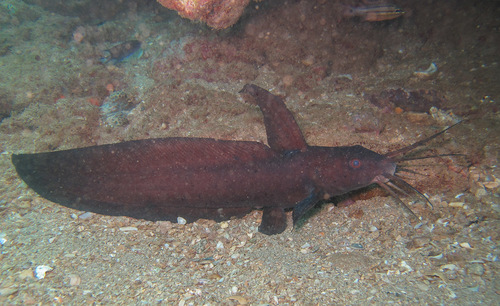
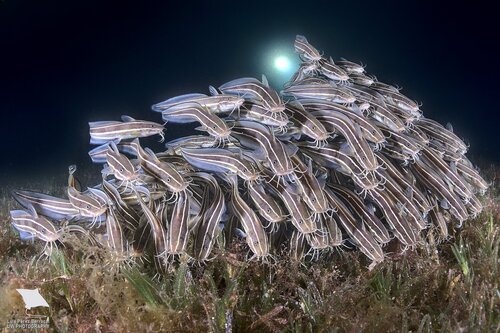
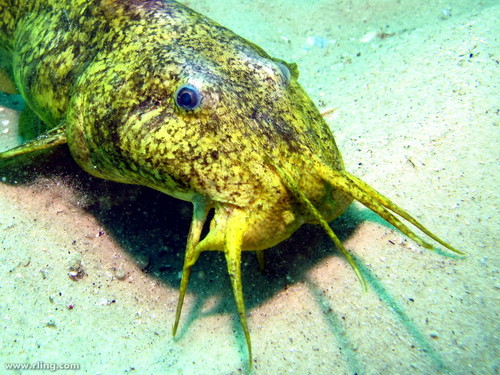
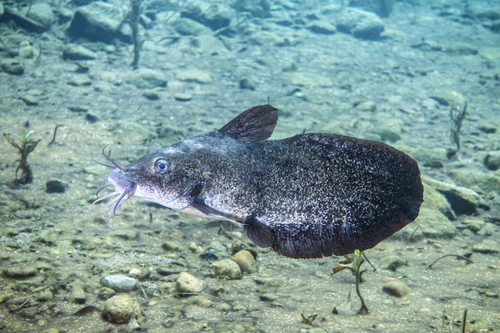
Eel-tailed catfish, Tandanus tandanus, commonly reach around 50.0 centimeters (19.7 inches) in length and weigh around 1.8 kilograms (4.0 pounds). Individuals of this species can grow to a maximum of around 90.0 cm (35.4 in) long and weigh up to 6.0 kg (13.2 lb). They can live for up to approximately 8 years. This fish has a large head with thick, fleshy lips, tubular nostrils, small eyes, and tough, smooth skin. Adult body coloration ranges from olive-green to brown, black, or purplish on the back, with a white underside. The fish is solid, nearly cylindrical, and elongate; the posterior half of its body tapers into a pointed, eel-like tail, and a continuous fin margin surrounds this tapered posterior section. It has a downturned mouth with fleshy lips surrounded by four pairs of barbels that help it feed. The sharp, serrated spines on its dorsal and pectoral fins are venomous, and can cause very painful wounds. Eel-tailed catfish live in slow-moving streams, lakes, and ponds with fringing vegetation, and swim close to sand or gravel bottoms. They are more abundant in lakes than in flowing water. While adults are usually solitary, juveniles may form groups. This species occurs in most freshwater habitats of the Murray-Darling river system, excluding the upland, sub-alpine, and alpine headwaters of southern tributaries. Speciated but undescribed forms of this fish are also found in several east coast river systems in northern New South Wales, from natural river capture events. Juvenile eel-tailed catfish eat zooplankton and small insects, especially chironomid larvae. Fish over 100 mm in length also eat small fish. Adult diets include shrimps and crayfish during warmer months, midge larvae in winter, plus mollusks, and dragonfly, caddis, and mayfly larvae. Eel-tailed catfish act as hosts for several types of intestinal parasites, including cestodes and nematodes. They spawn in spring and mid-summer, when water temperatures rise to between 20–24 °C (68–75 °F). They build their nests one to two weeks before spawning, constructing large nests up to one meter in diameter from small stones and gravel. Eggs are laid inside these nests, and one parent (sometimes both) guards the eggs until they hatch.