About Tanaecia lepidea (Butler, 1868)
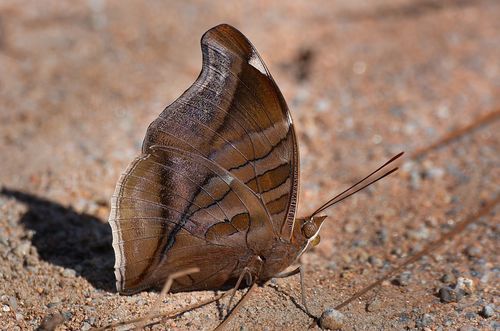
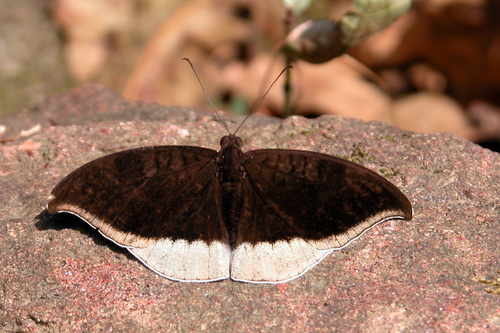
This species, Tanaecia lepidea, has the following morphological features. On the upperside, the base color is dark brown, which is paler in females. There are very faint black markings in the form of transverse lines across the cells of both the forewings and hindwings, plus an oblique discal fascia on the forewing. A continuous ash-grey band runs along the termen of both wings: it gradually broadens from the very narrow apex of the forewing to the tornus of the hindwing, where it covers roughly one-third of the wing. In females, this band has a narrow brown border along its outer edge. Cilia are white. Antennae, head, thorax, and abdomen are dark brown on their upper surface; underneath, antennae are ochraceous, while the remaining body structures are dusky white washed with ochraceous. On the underside, males are ochraceous brown, and females are bright ochraceous. In both sexes, color is paler on the hindwing. The terminal margins of both wings and the dorsal margin of the hindwing are suffused with lilacine-grey; this suffusion is somewhat narrow on the forewing, and much broader on the hindwing. The cells of both wings have dark brown sinuous transverse lines and loop-shaped markings. Both forewings and hindwings are crossed by somewhat diffuse broad dark discal bands and narrower dark postdiscal bands; these bands are prominent on the forewing and indistinct on the hindwing. Males have a patch of specialized dark scales above vein 4 on the upperside of the hindwing. This species is distributed in the lower Himalayas, ranging eastward starting from Almora. It is also found in the Western Ghats, central India, Orissa, Bengal, Assam, and the Malay Peninsula. It occurs in forested habitats.