About Tamiasciurus hudsonicus (Erxleben, 1777)
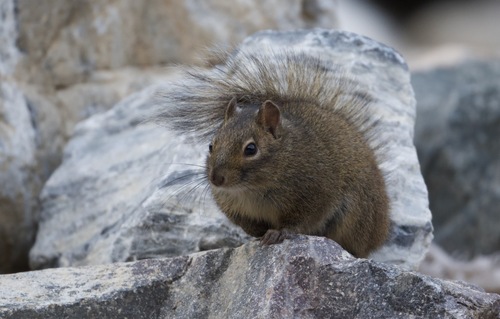
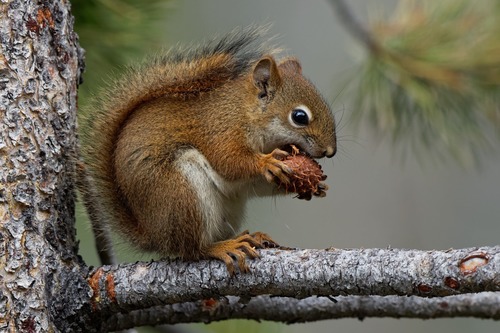
American red squirrels, scientifically named Tamiasciurus hudsonicus, can be easily told apart from other North American tree squirrels by three key traits: their smaller total body size (28–35 cm or 11–14 inches, including the tail), territorial behavior, and reddish fur with a white underbelly (called a venter). They are somewhat larger than chipmunks. The Douglas squirrel is very similar in physical form to American red squirrels, but Douglas squirrels have a rust-colored underbelly, and are limited to the southwestern coast of British Columbia and the Pacific Northwest of the United States. The ranges of American red squirrels and Douglas squirrels overlap in southern British Columbia, northwestern Washington, and eastern Oregon. American red squirrels are widely distributed across the North American continent. Their range covers most of Canada, excluding northern areas with no tree cover, the southern half of Alberta, and the southwestern coast of British Columbia; it also includes the southern half of Alaska, the Rocky Mountains region of the United States, and the northern half of the eastern United States. Across most of their range, American red squirrels are abundant and are not a conservation concern. They were introduced to Newfoundland, and have existed there in abundant numbers for decades. The endangered subspecies grahamensis, found only on Mt. Graham, Arizona, was formerly classified as a member of this species, but is now considered a subspecies of the southwestern red squirrel Tamiasciurus fremonti. American red squirrels are spontaneous ovulators. Females only enter estrus for one day, but they leave their territory before ovulation, and these exploratory trips may act as an advertisement for their upcoming estrus. On the day of estrus, several males chase the female in an extended mating chase. Males compete with each other for the chance to mate with the estrous female. Estrous females will mate with between 4 and 16 males. Reported gestation length ranges from 31 to 35 days. Females can breed for the first time when they are one year old, but some females delay breeding until they are two years old or older. Most females produce one litter per year, but some skip reproduction entirely in some years, while a few females breed twice in other years. Litter sizes typically range from one to five offspring, though most litters contain three or four. At birth, offspring are pink, hairless, and weigh roughly 10 grams. While nursing, offspring grow approximately 1.8 grams per day, and reach full adult body size at 125 days old. They first leave their natal nests at around 42 days old, but continue nursing until approximately 70 days old. Nests are most often built from grass in the branches of trees. Nests may also be made inside witches' broom — abnormally dense vegetative growth caused by a rust disease — or inside cavities in the trunks of spruce, poplar, and walnut trees. American red squirrels rarely nest below ground. Each individual squirrel maintains multiple nests within its territory, and females with young move their offspring between these nests. There are reports of American red squirrels building nests inside human dwellings, using insulation as nesting material. A three-year study of a red squirrel population in southwest Yukon found that female red squirrels had high rates of multiple-male mating, and would even mate with males that shared close genetic relatedness. Parental relatedness had no effect on either the birth mass or growth rate of offspring, nor did it impact offspring survival rate to one year of age.