About Tamiasciurus douglasii (Bachman, 1839)
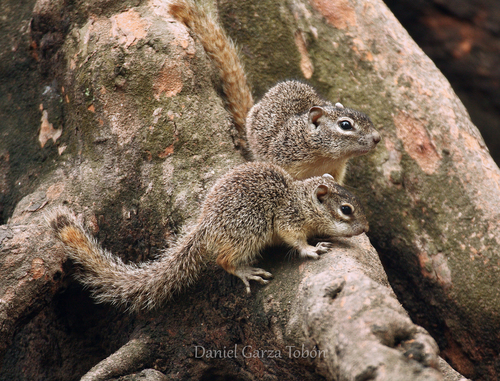
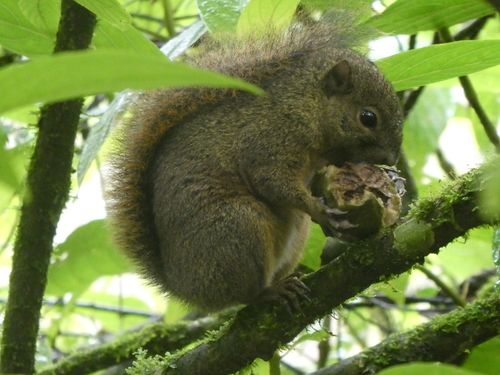
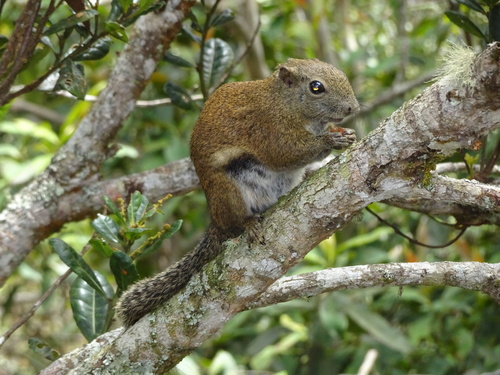
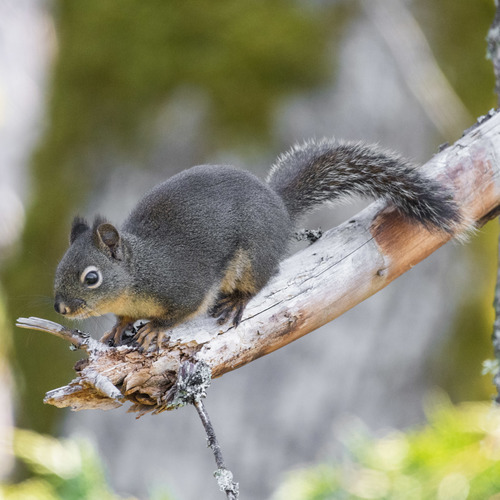
John Muir described the Douglas squirrel (Tamiasciurus douglasii) as "by far the most interesting and influential of the California Sciuridæ". A fully mature Douglas squirrel reaches about 33 cm (13 in) in total length, including a tail around 13 cm (5 in) long, and weighs between 150 and 300 g (5.3 and 10.6 oz). This species' appearance changes with the seasons. In summer, its back is greyish or nearly greenish-brown, its chest and belly are pale orange, and its legs and feet are brown. In winter, its coat becomes browner, its underside turns grayer, and its ears grow noticeably more tufted than they are in summer. Like many other squirrel species, Douglas squirrels have a distinct white eye ring. Douglas squirrels inhabit coniferous forest habitats along the Pacific Coast, ranging from the Sierra Nevada mountains of California north to the southwestern coast of British Columbia. They prefer old-growth forests or mature second-growth forests, and some researchers consider the species dependent on the presence of these forest types. Mearns's squirrel, a distinctive subspecies of the Douglas squirrel, lives instead in xeric pine forests in a small area of Baja California. Across most of the Douglas squirrel's range, the species fills the same ecological niche that the American red squirrel occupies in coniferous forests across the rest of North America. The two species have very little overlapping territory. Douglas squirrels are territorial. In winter, each individual squirrel holds a territory of approximately 10,000 square metres, but during the breeding season a mated pair will defend a single shared territory together. Douglas squirrels are diurnal and active year-round, and they often chatter loudly when intruders enter their territory. On summer nights, they sleep in ball-shaped nests they construct in trees, while in winter they roost in tree hollows. Any groups of Douglas squirrels seen together in summer are most likely juvenile squirrels from a single litter.