About Tamias speciosus Merriam, 1890
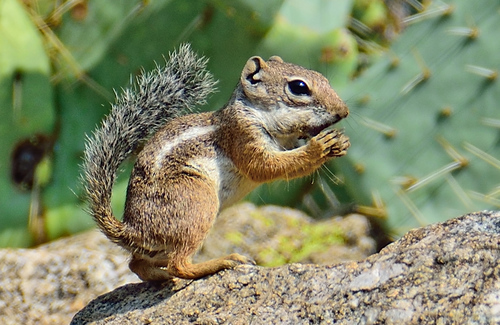
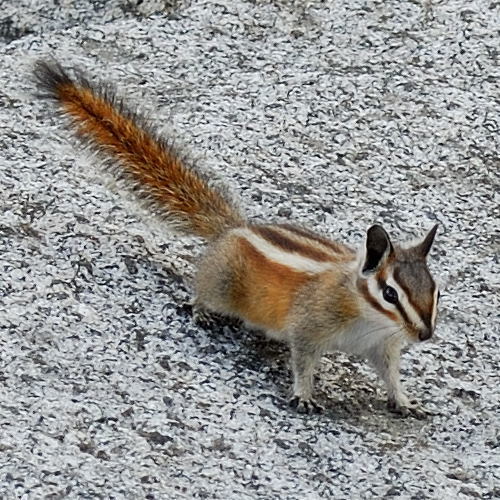
This species is the Lodgepole chipmunk, with the scientific name Tamias speciosus Merriam, 1890. Females of this species are larger than males. Females have an average body weight between 55 and 69 grams, while males average 50 to 60 grams. Female body length ranges from 197 to 229 mm (7.8 to 9.0 in), and male body length ranges from 200 to 222 mm (7.9 to 8.7 in). Females also have longer tails than males; overall tail length for the species ranges from 13 to 22 cm (0.51 to 0.87 in), with a black tip and a cinnamon-colored body. Both sexes share the same consistent body patterns: characteristic white dorsal and facial stripes, where the central dorsal stripes are less prominent and more yellow-white than the lateral white stripes. Compared to its close relatives, this species has darker and broader facial stripes. Other distinct markings include dark black dorsal stripes, no black stripe underneath the prominent white lateral stripe, bright orange sides, orange-gray shoulders, a gray under-belly, a gray rump, and a brown crown with mixed gray coloring. The Lodgepole chipmunk's distribution extends from the high Sierra Nevada, San Jacinto, San Bernardino, and San Gabriel Mountain ranges of California into the Lake Tahoe region of the west central corner of Nevada. This species inhabits subalpine coniferous forests made up primarily of multiple pine species (Lodgepole, Jeffrey, Ponderosa, and Sugar) and fir species (Douglas, white and red). Individuals can be found foraging on rocks and fallen logs across the forest floor. In 1978, Mark A. Chappell conducted a removal experiment that included four different chipmunk species to examine species removal processes. The experiment noted that all four species were allopatric, meaning they had non-overlapping range borders in their Sierra Nevada habitat, with each species occupying a different elevation zone in the range. The Lodgepole chipmunk (here noted as N. speciosus) was observed living between 2400 and 3000 meters in the lodgepole pine zone, located between the alpine zone (over 3000 meters) and the Piñon pine/mountain mahogany zone (1900 to 2400 meters). This division of different zones within a single area by ecological competition is determined by physiological and environmental limits, with each species restricted to the zone that best matches its habitat preferences. From 1999 to 2000 and 2002 to 2003, an investigation into the effects of burning and mechanical thinning was carried out in the southern Sierra Nevada Mountains. The study captured Lodgepole chipmunks to assess impacts, and results showed that over the short term, these forest management techniques did not have a significant effect on the species' capture rate or population size. However, the study found that the body mass of Lodgepole chipmunks decreased because the treatments altered forest structure, reducing food availability from tree cones. For reproduction, both males and females use visual displays and vocalizations during courtship. A male is ready to mate when his scrotum turns black and his testes are loosely relaxed. Lodgepole chipmunks breed once per year, between May and early June. After a one-month gestation period, three to six pups are born in early June. Pups are poorly developed at birth, and are nourished by maternal lactation for approximately one month. Young chipmunks become independent by Fall, and reach sexual maturity the following spring. While this has not been confirmed for the species, it is expected that Lodgepole chipmunks have a polygynous mating system, similar to their close relatives. Parental investment falls entirely to the mother, as males do not provide any care for their offspring.