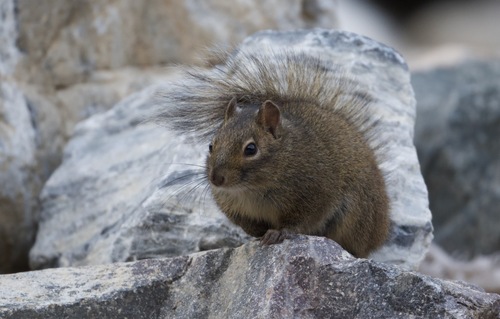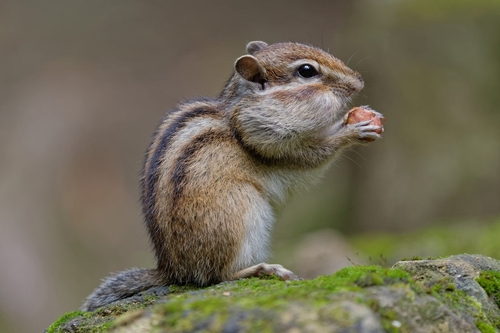
About Tamias sibiricus (Laxmann, 1769)
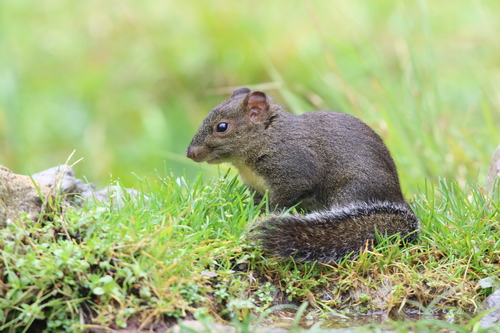
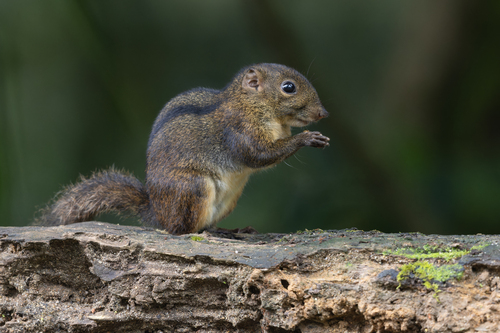
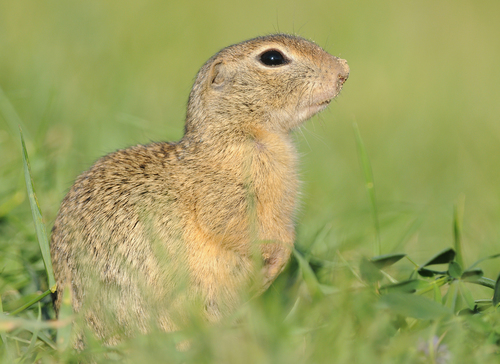
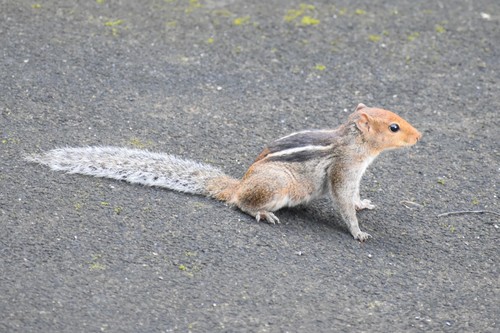
Description: The Siberian chipmunk (Tamias sibiricus) has four white stripes and five dark stripes running along its back. Its total body length ranges from 18 to 25 cm (7.1 to 9.8 in), with the tail making up one third of this total length. Adult weight varies with time of year and food availability, and normally falls between 50 and 150 g (1.8 to 5.3 oz). This species shows slight color variation across different geographic regions, and does not have sexual dimorphism. The only way to distinguish younger and older Siberian chipmunks is through size and body proportions. Its small size is linked to its relatively short wild lifespan of 2 to 5 years; in captivity, it can live up to 10 years.
Distribution: The Siberian chipmunk is the only chipmunk species found outside North America. It is native to northern European Russia, Siberia extending to Sakhalin and Kunashir, extreme eastern Kazakhstan, northern Mongolia, northern and central China, Korea, and the Japanese islands of Hokkaido, Iturup, Rishiri, Rebun, Teuri, and Yagishiri. One confirmed introduced population exists in Karuizawa on the Japanese island of Honshu. In the 1960s, South Korea began exporting Siberian chipmunks to Europe as pets, with over 200,000 individuals exported between 1960 and 1980. By the 1970s, the species was sighted in European parks, and small resident populations have established in suburban forests and urban parks of Belgium, France, Switzerland, Germany, Italy, the Netherlands, Austria, and Great Britain. These introduced populations formed when pet owners released unwanted individuals intentionally, or when chipmunks escaped from captivity into European forested areas. The Dutch population, for example, originated from escapees of the closed former Tilburg zoo, where many chipmunks were left behind after other animals were relocated because they lived underground. Despite thousands of introductions, the species is not highly invasive and spreads naturally slowly at 200 to 250 metres (660 to 820 ft) per year, which has kept it from spreading far from original introduction sites. By 2009, 22 introduced populations had been identified across Europe, 11 of which were in France, all recorded in forests and urban parks since the 1970s; not all of these populations may still exist today.
Habitat: The Siberian chipmunk can survive in a wide range of habitats and environmental conditions. Its native habitats most commonly include coniferous forests, stony areas within forests and mountains, shrub-dense habitats, areas alongside waterways or roads, and small patches of agricultural land. Introduced European populations usually occupy deciduous forests, mixed deciduous-coniferous forests, or urban green areas. This species tolerates conditions across latitudes from 29°N to 69°N, and temperatures from −65 °C to 30 °C. However, the Siberian chipmunk has low dispersal ability. Since it is mostly introduced into wooded forests or urban green areas, it rarely disperses naturally to new regions, and struggles to cross both natural and human-made obstacles such as swamps or roads. It lives in loose colonies, with each individual occupying its own territory. Territory size ranges from 700 to 4000 m2; territories are larger for females than for males, and larger in autumn than in spring. The species marks its territory using urine and oral glands located inside its cheeks, a behavior that functions as intraspecific communication.
Reproduction: Siberian chipmunks are iteroparous and viviparous. Their breeding season begins in mid-April, right after hibernation ends. They typically breed only once or twice per year, producing litters of three to eight offspring. Gestation lasts 28 to 35 days, and young are born blind, hairless, and weigh between 3 and 5 g (0.11 to 0.18 oz). Offspring open their eyes around 20 to 25 days after birth. Females are solely responsible for caring for young, and teach them to forage when they are around six weeks old. Weaning is completed around seven weeks after birth, and juveniles become independent at around eight weeks. They reach full adult body mass between three and four months old, and both males and females reach sexual maturity by nine months of age.
Ecology: Siberian chipmunks are an important food source for many predators, including diurnal raptors, weasels, small cats, hawks, owls, and foxes. They avoid predation by staying alert, hiding in burrows, and using camouflaged fur to blend into their surroundings. The species helps distribute plant seeds and fungal spores, and other wildlife feed on the food it stores. It may also help control forest tree pests. In Russia, Siberian chipmunks consume around 50 percent of available forest nuts. In Belgium, they have been recorded preying on low-nesting birds. If the species became established in Britain, it could potentially compete with native small animals including the red squirrel, wood mouse, and bank vole.