About Tamias minimus Bachman, 1839
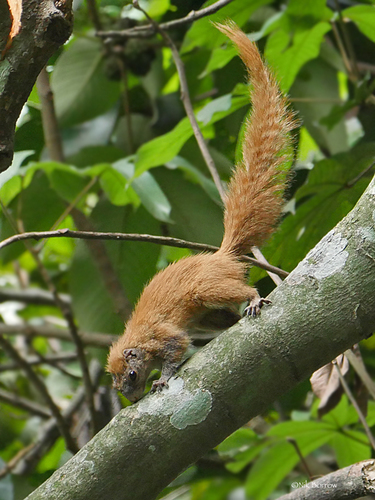
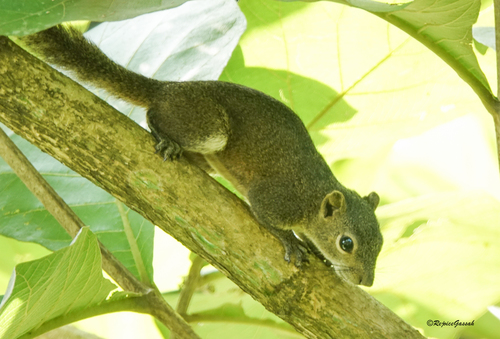
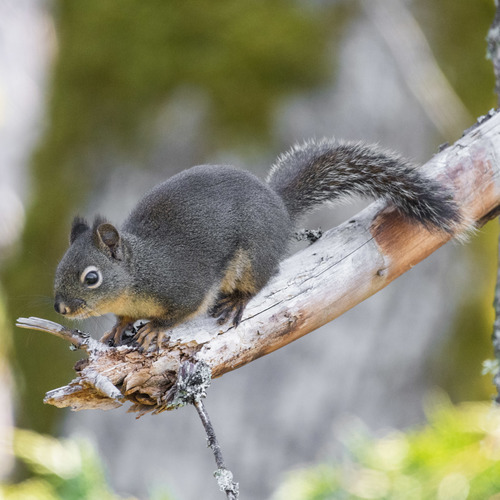
This species, the least chipmunk, is the smallest chipmunk species. It has a total body length of approximately 15.7–25 cm (6.2–9.8 in) and weighs between 25–66 g (0.88–2.33 oz). Its sides range in color from gray to reddish-brown, and its underparts are grayish white. Five dark brown to black stripes run along its back from the nape of the neck to the base of the tail, separated by four white or cream-colored stripes. Two light and two dark stripes run across its face from the tip of the nose to the ears. Its bushy tail is orange-brown and measures 10–11 cm (3.9–4.3 in) long. Where its range overlaps with the yellow-pine chipmunk, it can be difficult or impossible to tell the two species apart in field conditions, and laboratory examination of skeletal structures may be needed for correct identification. Like other chipmunks, it has four toes on each forefoot and five toes on each hindfoot. Females have eight teats. Its brain-to-body mass ratio is lower than that of other chipmunk species that live in the same area, which suggests it prefers less complex environments. Least chipmunks are distributed across most of the western United States, ranging from northern New Mexico and western North and South Dakota to eastern California, Oregon and Washington. They also live throughout much of southern and western Canada from Yukon and southeastern British Columbia to central Ontario, and extend into the Upper Peninsula of Michigan and adjacent parts of Wisconsin and Minnesota. Up to 21 subspecies have been identified across this range. Least chipmunks are less arboreal than other chipmunks. They are most commonly found in sagebrush habitats, coniferous woodland, and along rivers, but also occur in alpine meadows and on the edges of the northern tundra. In spring, females enter estrus within one week of emerging from their burrows, and mating typically occurs between March and May. Gestation lasts 28 to 30 days, and females produce one litter of three to seven young per year. If a female loses her first litter shortly after birth, she may sometimes be able to breed again in the same year. Young least chipmunks are born hairless and blind, measuring around 5 cm (2.0 in) long and weighing 6 g (0.21 oz). They gain the ability to stand and open their eyes at 27 days old, and are weaned at 36 days old. They reach sexual maturity at one year old, but do not always breed until their second year. They can live up to six years in captivity.