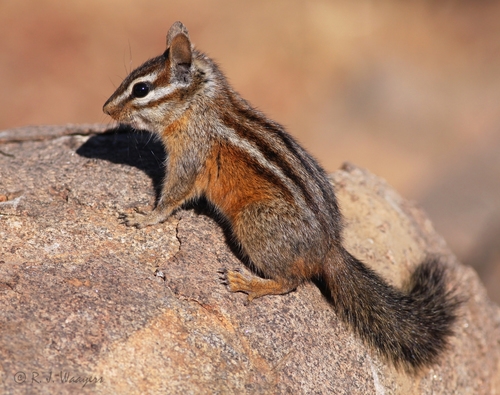
About Tamias merriami J.A.Allen, 1889
Tamias merriami J.A.Allen, 1889, commonly known as Merriam's chipmunk, has grayish-brown fur marked with dark and light dorsal stripes. It has light gray or white stripes surrounding its eyes and a white underbelly. Its tail is very bushy, and its length is often over 80% of the combined length of the animal's head and body. Both body and tail fur are shed through regular molting. This species has a dental formula of 1.0.2.3 / 1.0.1.3 × 2, giving a total of 22 teeth. Merriam's chipmunk is distributed across parts of central California, southern California, and Baja California, including along the western slope of the Sierra Nevada mountains. Individuals have been recorded at altitudes as high as 2,940 meters, but the species most commonly occurs at elevations below 1,200 meters. It primarily lives in forest and chaparral shrubland habitats, occupying areas that have a mix of trees, shrubs, logs, rocks, and plant litter, which the chipmunks use for food and shelter. During mating, females attract males by emitting calls that last between ten and fifteen minutes. When a male hears the call, he responds by running to the female and jumping around her. After the male approaches, the female squats down, and the male performs 12 to 24 thrusts. The entire mating process takes approximately fifteen seconds.