About Tamias cinereicollis J.A.Allen, 1890
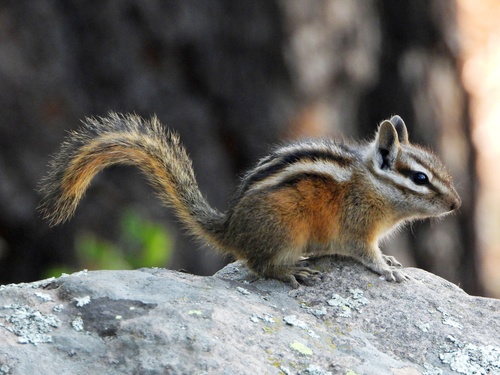
Scientific name: Tamias cinereicollis J.A.Allen, 1890, common name gray-collared chipmunk. This chipmunk reaches a total length of around 225 mm (9 in), with a tail that measures about 98 mm (4 in). Its forehead is greyish-brown, and three dark stripes run along each side of its head; the central stripe passes through the eye. These dark stripes are separated by white bands. Its cheeks, neck, shoulders, upper back, and rump are all grey. The remaining upper surface of the body is yellowish-brown, marked with five black or dark brown stripes across the back and sides; the outermost pair of these stripes can be hard to distinguish. The underparts of the chipmunk are pale yellowish-brown. The upper side of the tail is black, while the underside is creamy-white, and both surfaces are tinged with buff. Its feet are pinkish-buff. The grey coloring on the face and the distinct grey collar separate this species from other members of the genus Neotamias. For distribution and habitat: the gray-collared chipmunk lives in mountain coniferous forests in central and eastern Arizona, and in central and western New Mexico. Its range extends from the Bill Williams Mountains, San Francisco Mountains, and White Mountains to the Datil Mountains, Magdalena Mountains, and San Mateo Mountains. Its altitudinal range spans 1,950 to 3,440 metres (6,400 to 11,290 ft), but it is most commonly found between 2,100 and 3,300 metres (6,900 and 10,800 ft). It occurs in ponderosa pine and spruce-fir forests, often reaching up to the timberline. It is most common in areas where pine and Douglas fir grow together, and it can also be found in oak and juniper forests.