About Tamarix parviflora DC.
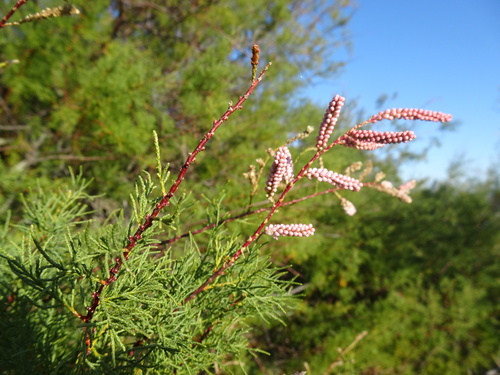
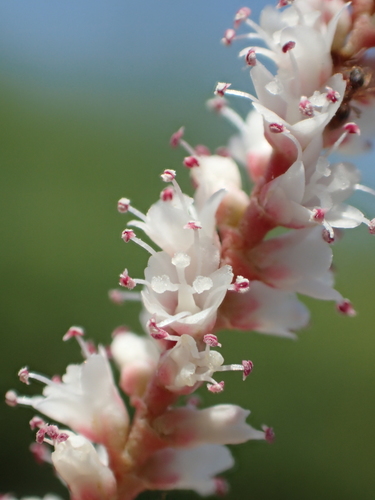
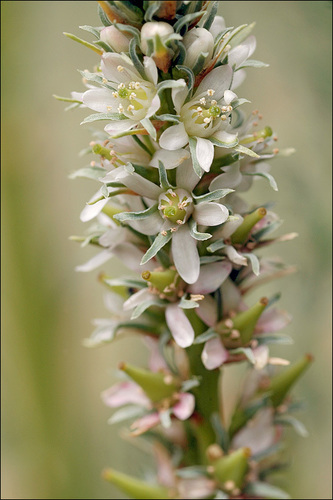
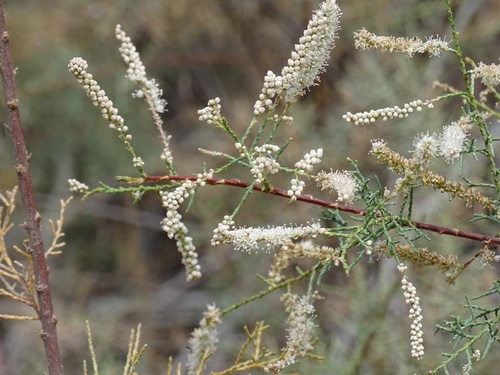
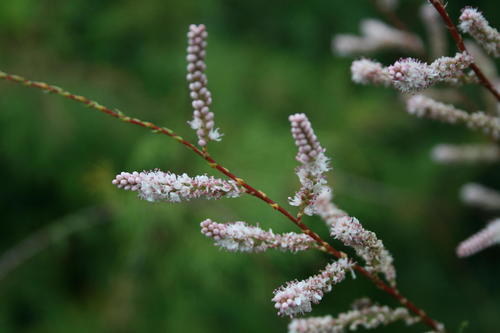
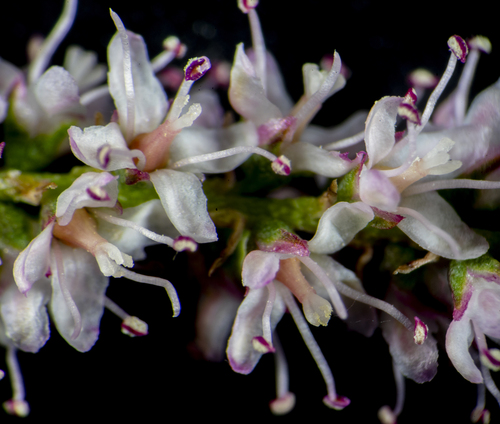
Tamarix parviflora, commonly known as smallflower tamarisk, is a species of tamarisk. It is native to southeastern Europe, including Albania, the East Aegean Islands, Greece, Crete, and the former Yugoslavia, as well as Turkey. It has been introduced to many other regions: Algeria, Austria, Cape Provinces, Corsica, Italy, Libya, Mexico, Pakistan, Sicily, Spain, the West Himalayas, and western North America, which includes Arizona, California, Colorado, Illinois, Kansas, Kentucky, Mississippi, Nevada, New Mexico, New York, North Carolina, Oklahoma, Oregon, and Texas. In these introduced areas, it is classified as an invasive species. It readily grows in moist habitats, particularly in saline soils. It is a shrub or tree that reaches up to approximately 5 meters in height. Its branching twigs are covered in tiny linear leaves that are no longer than 2 to 3 millimeters. The inflorescence is a dense spike of flowers that measures 1 to 4 centimeters long. Each tiny flower has four pink petals. This species was first published and described by Augustin Pyramus de Candolle in Prodr. volume 3 on page 97, in 1828.