About Tamarix chinensis Lour.
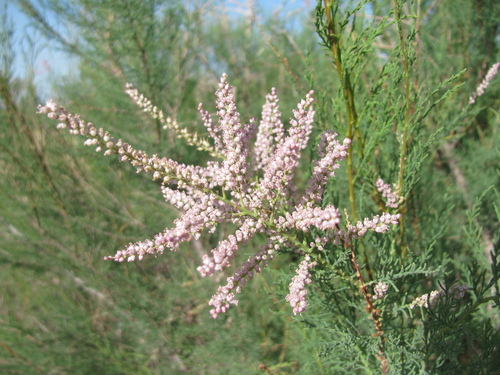
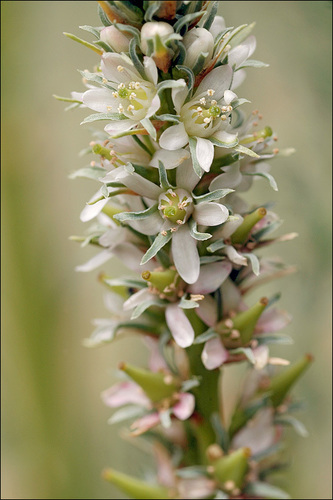
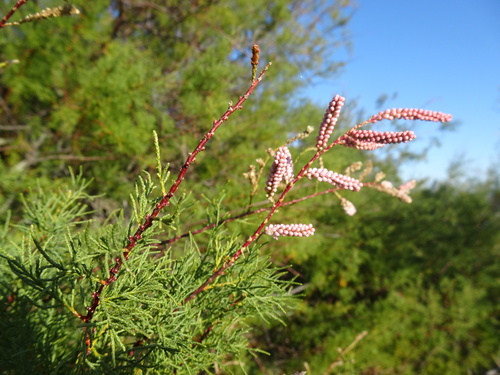
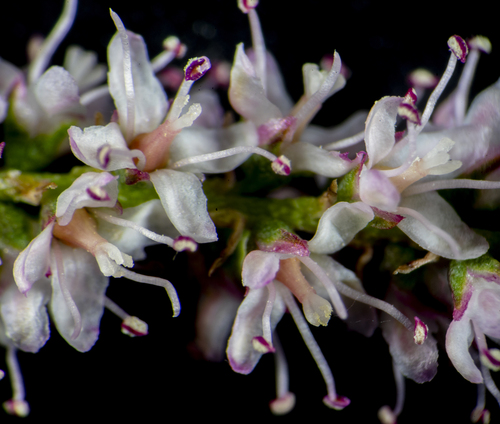
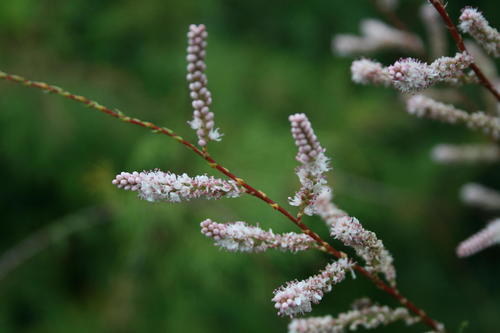
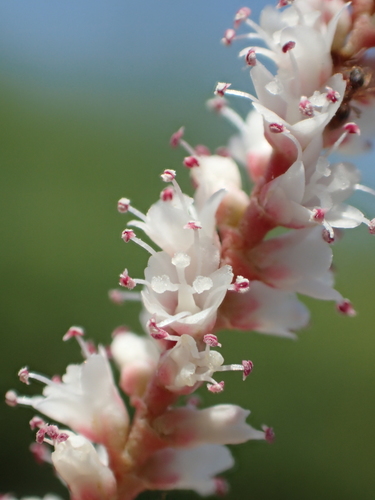
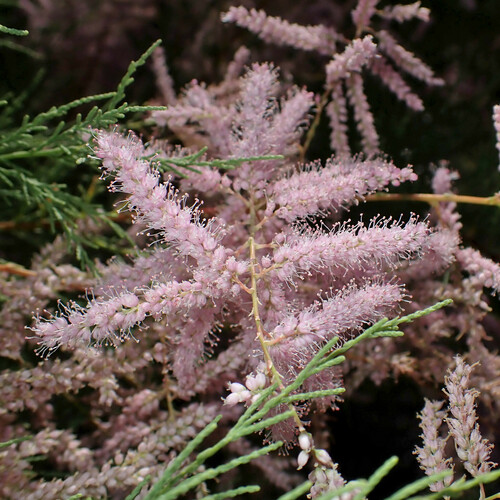
Tamarix chinensis Lour. is a species of flowering plant in the Tamaricaceae family. Its common names include five-stamen tamarisk, Chinese tamarisk, and saltcedar. The species is native to China and Korea, and is present as an introduced species across many other regions, where it is sometimes classified as an invasive noxious weed. It grows readily in moist habitats with saline soil. It can grow either as a single-trunked tree or a multi-stemmed shrub with several spreading erect branches, reaching a maximum height of 6 meters or more, and has been recorded growing up to 12 meters tall. Its bark can be reddish, brown, or black. Small, multibranched twigs are covered in small, lance-shaped, scale-like leaves that measure no more than about 3 mm long. Its inflorescence is a dense raceme of flowers that is a few centimeters long. Each fragrant flower has five petals, which are usually pink but can range from white to red in color. This tamarisk commonly hybridizes with T. ramosissima in its invaded range in North America. It has become an aggressive invader of wildlands in the southwestern United States, where it was originally planted as an ornamental. It can reproduce vegetatively from its roots, and also from its foliage if covered by soil, such as during sediment-rich flooding. It also reproduces by seed: its seeds are tiny, tufted with hairs, and disperse easily via wind. Despite its reputation as a noxious weed, Tamarix chinensis can be useful for wood production, honey production, and provides nesting sites for various bird species. In its native habitat in China, the plant forms thickets that act as effective barriers along waterway margins, including saline ocean shores.