About Talostolida teres (Gmelin, 1791)
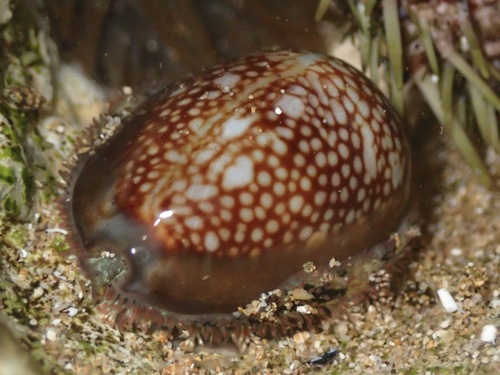
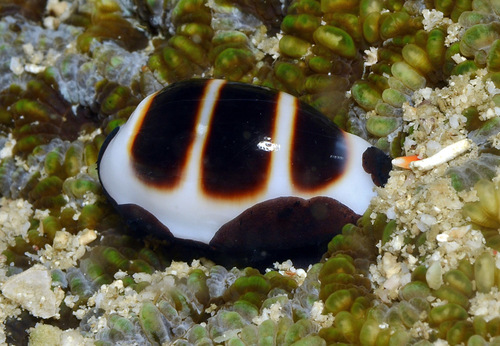
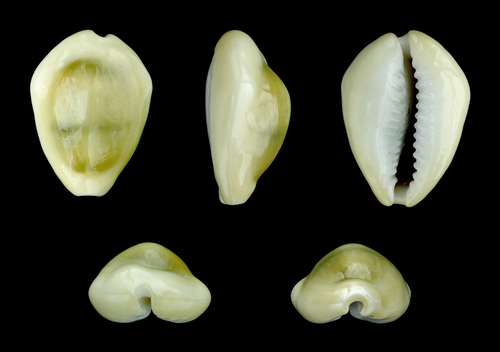
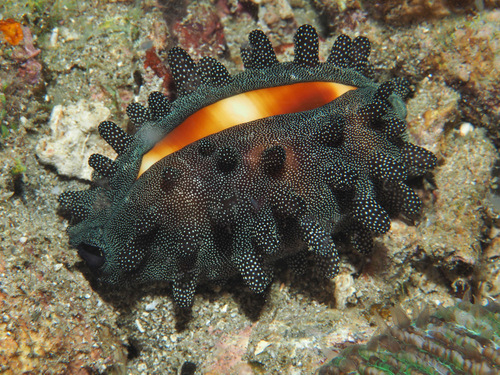
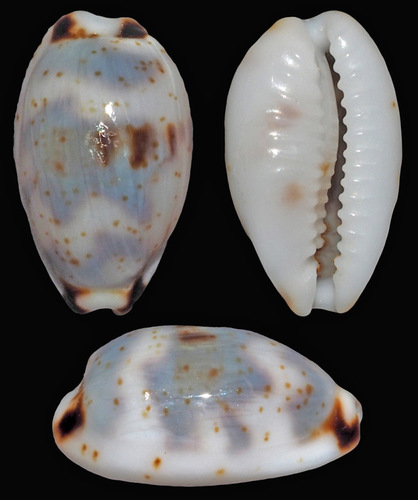
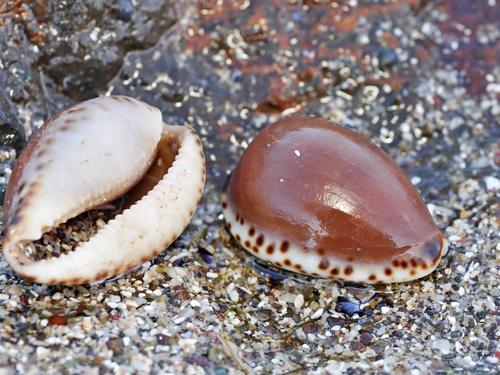
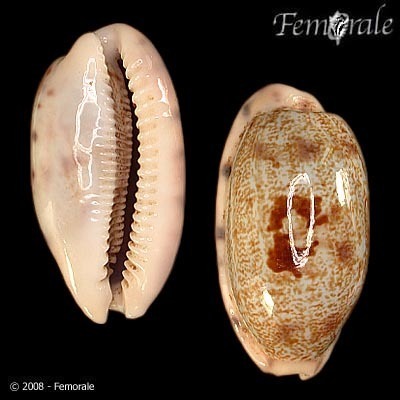
Talostolida teres, originally described by Gmelin in 1791, is a fairly common species of cowrie. The shells of adult cowries of this species range from a minimum length of 8 millimetres (0.31 in) to a maximum length of 44 millimetres (1.7 in), with an average adult shell length of 25–32 millimetres (0.98–1.26 in). Shells are highly variable in both color and pattern, and are cylindrical or sub-cylindrical in shape. The smooth, shiny dorsum surface has a base color of whitish, greenish, or pale brown, marked with irregular dark brown patches that sometimes form two to three transverse bands; some shells are completely grey-greenish overall. The shell margins are white or pale brown, with scattered dark dots and a prominent labial callus. The base of the shell is white or pinkish, with fine, short teeth. Living individuals have an orange-reddish mantle that bears white sensory papillae. Both the mantle and foot are well developed, and the species has external antennae. This species and its subspecies have a broad distribution: they occur in the Red Sea, the Indian Ocean off the coasts of East Africa and South Africa (including Aldabra, Chagos, the Comores, Kenya, Madagascar, the Mascarene Basin, Mauritius, Mozambique, Réunion, the Seychelles, Somalia and Tanzania), and both the Western and Eastern Pacific Ocean along Western Australia, Philippines, Bali, East Timor, Solomon Islands, Papua New Guinea, Vanuatu, Tahiti, New Caledonia, Fiji, Taiwan and Hawaii. The subspecies Blasicrura teres pellucens (Melvill, 1888) is additionally found around the Galapagos Islands and Panama. These cowries inhabit the intertidal zone, where they live on rocks or under corals.