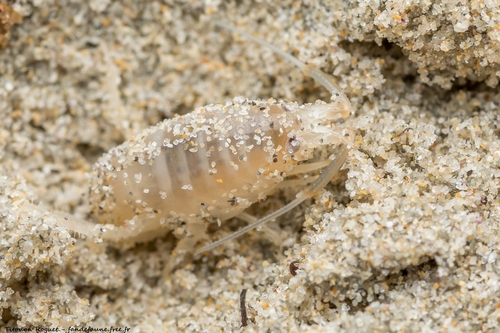
About Talitrus saltator (Montagu, 1808)
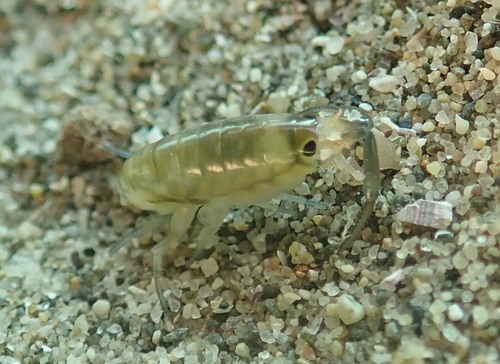
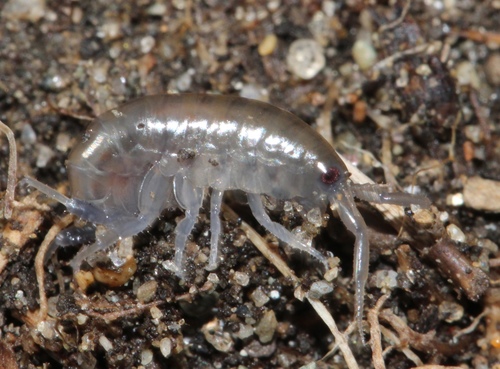
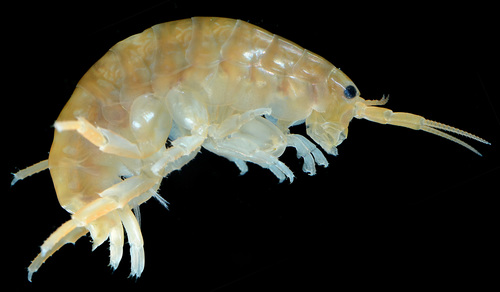
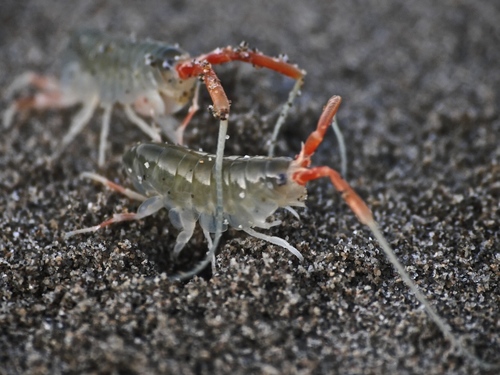
Talitrus saltator (Montagu, 1808) adults reach lengths between 8.2 millimetres (0.32 in) and 16.5 mm (0.65 in), and males are slightly larger than females. Its body is grayish-brown or grayish-green, it has one pair of black eyes, and one distinct pair of antennae where one antenna is more robust than the other. Talitrus saltator is found around the coasts of the North Sea and north-east Atlantic Ocean, ranging from southern Norway to the Mediterranean Sea. Across most of its range, its daily cycle is strongly linked to tides, and it can make daily migrations of up to 100 metres (330 ft). In areas with no significant tides, such as parts of the Mediterranean, it uses visual cues to regulate its daily cycle instead. Mating in T. saltator occurs once the photoperiod exceeds 14 hours. This differs from other shoreline animals like isopods, which control breeding timing using air or sea temperature. Mating takes place during the species' nightly migration down the beach, after the female has moulted. Females carry broods of 13 to 15 eggs. When newly hatched, juveniles are sensitive to desiccation and cannot burrow, so they live in washed-up seaweed that has a humidity of 85% to 90%. Juveniles become sexually differentiated within a few months, but do not take part in the second reproductive wave later in the same year, and reproduce for the first time the following year. Females die before males, during their second winter. Males live up to 21 months, while females live 18 months. During winter, adult T. saltator burrow into sand until they reach a layer with 2% moisture content, which may require digging up to 50 centimetres (20 in) deep. Ecologically, T. saltator spends the day buried at depths of 10–30 cm (3.9–11.8 in) above the strandline, and emerges at night on the falling tide to feed. It can navigate toward the sea using multiple indicators: the angle of the sun, the angle of the moon, detection of blue wavelengths of light from the sea, and recognition of the red-brown colors of land. Its diet consists mainly of rotting seaweed that accumulates on the strandline, and the species is an important food source for shore birds.